
Polgoon: Salt, Tunnels and a Quiet Revolution in Cornish Wine
14 Nov 2026 · @Carlos
A vineyard walk with John and a seven-wine tasting with Debbie show how far one of England's most westerly estates has travelled.
Polgoon makes some of the most distinctive wines I have tasted in England, and they have changed enormously since I first tried them twelve years ago. That was my verdict after two days at the estate, a short drive from my home in Newlyn.
I arrived at noon on a bright November day. The gravel track rises past a pale-blue corrugated barn with the navy Polgoon sign, the "Open" boards and a palm tree at the corner, a very Cornish combination. John met me, as friendly and welcoming as ever, and took me straight out to the vines.
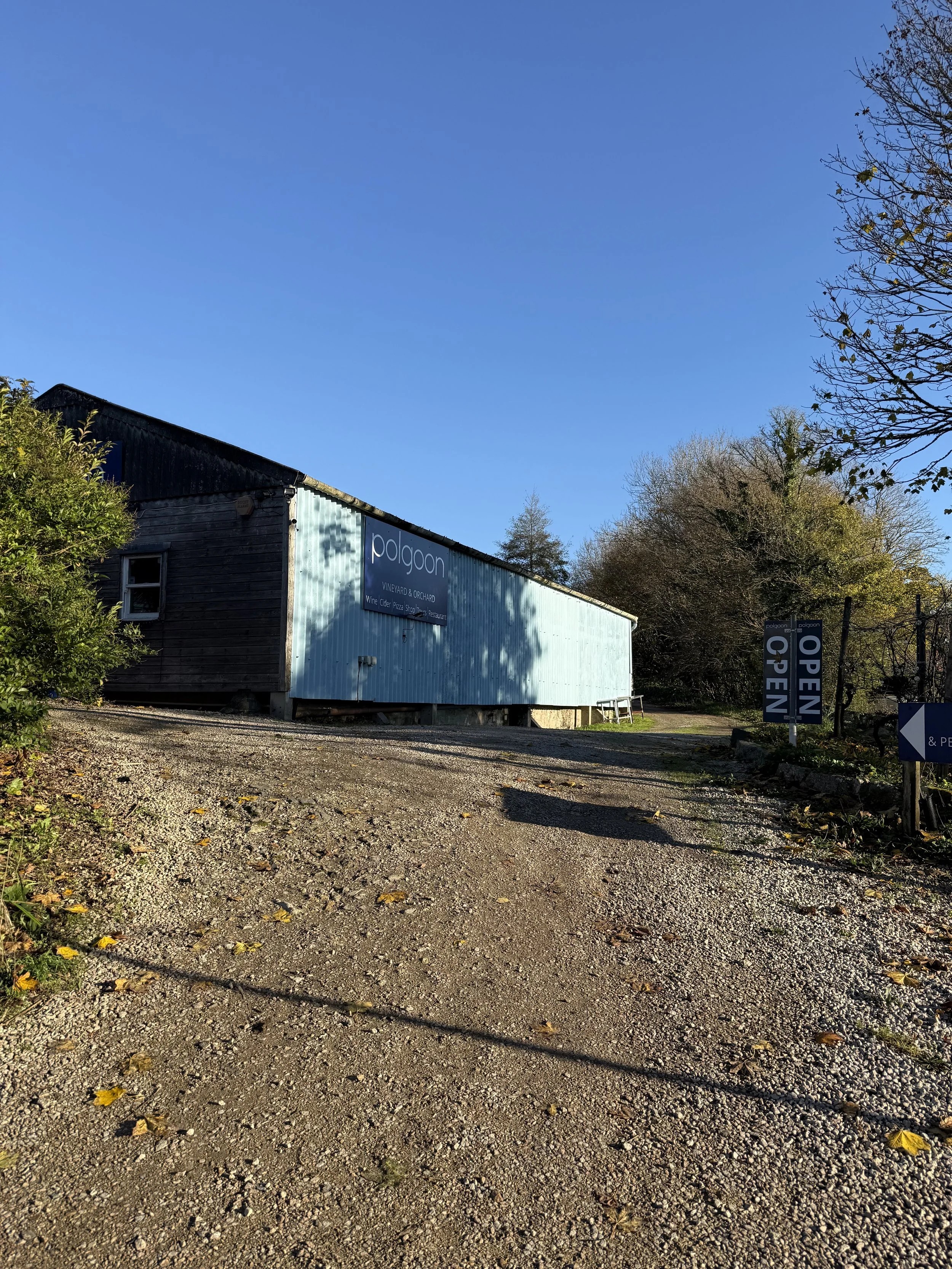
The track up to the Polgoon barn on a clear November morning.
Under the tunnels
Polgoon's biggest decision was about rain, not climate. When I asked what had changed most since the first harvest in 2006, John didn't talk about weather trends. He talked about polytunnels.
"The biggest change for us was putting up tunnels, Spanish tunnels, and growing in the tunnels so that we could get away from the disease and Botrytis," he said. In Cornwall, rot follows the rainfall.
The idea came from an unlikely place. John had seen raspberry growers using the same structures and wondered whether vines would respond the same way. After two or three poor years, he covered a first section in 2010. "It means we get a crop every year," he told me. "We get better ripeness, we get better fruit set."
In November the plastic is rolled down and tied along the rows, so the steel hoops stand bare over the dormant canes. It looks almost skeletal, but it is the reason Polgoon can rely on a harvest in a county where rain is the grower's first enemy.
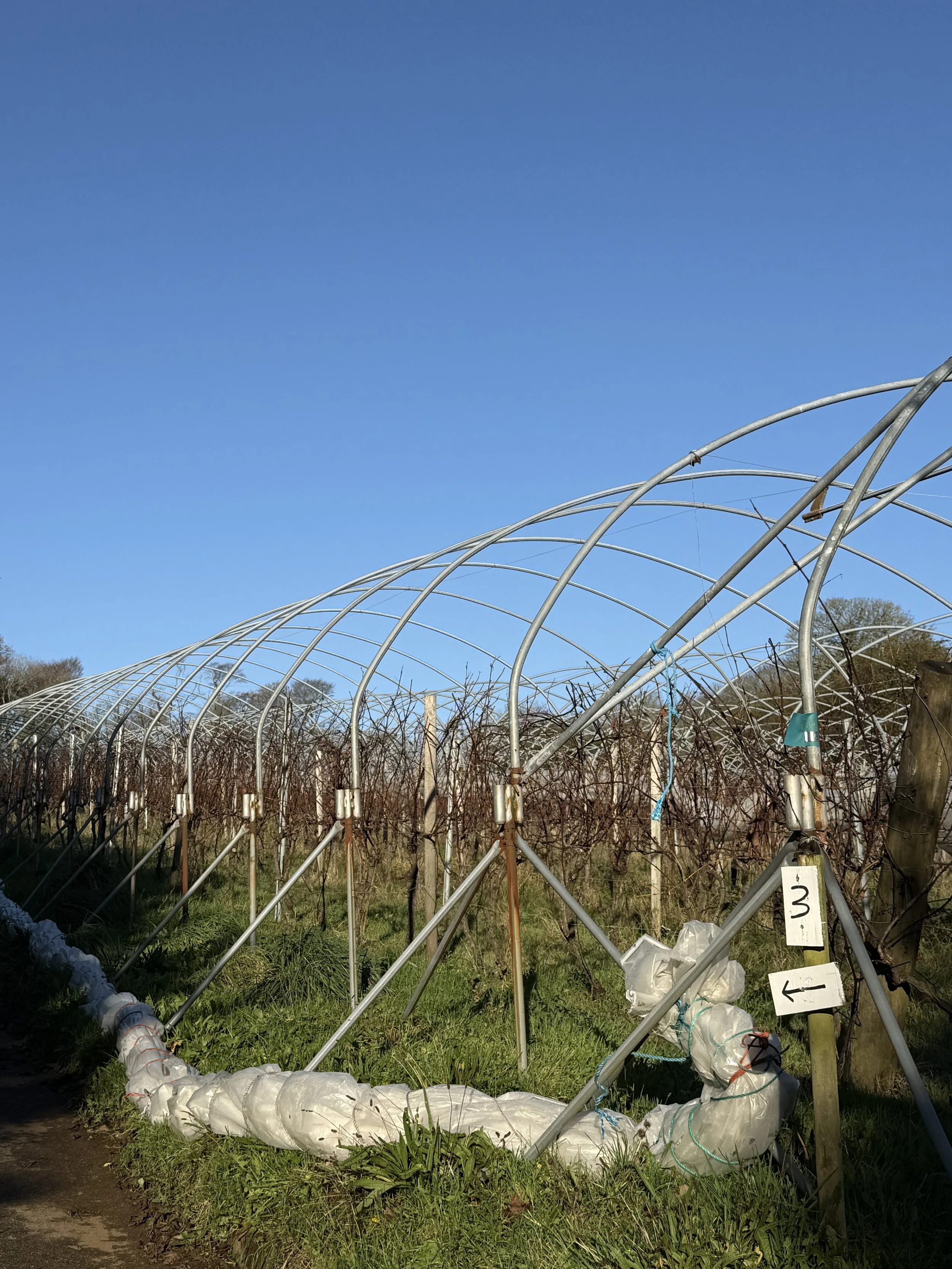
Spanish tunnels in winter: the plastic rolled down, the vines dormant.
A hard year: 2026
This year, for the first time, Polgoon lost a lot of fruit to powdery mildew, which infected the vineyard after all the hot, and dry weather. "Normally we're fighting Botrytis," John said. "We have a little bit of powdery mildew. But this year, because of the warm, dry conditions, we weren't really expecting it." Two varieties were lost.
The varieties that escaped did well. Rondo and Seyval Blanc both gave a very good crop. John was quick to add that many English vineyards had an excellent 2026; Polgoon simply got caught by the disease nobody expected in a dry year.
A grower who speaks his mind
John's strongest view is that English wine is betting too much on sparkling. At 64, he isn't planning new plantings. "What we've got at the moment is pretty good for where we are, and we're happy with the wines we're making." But he sees a mistake being made across the country.
"We've got a great variety here that's grown in this country, Bacchus, that makes a fantastic wine," he said, "and people are grubbing it up now, because they're replacing it with Pinot Noir for making sparkling. I think it's quite short-sighted, really."
He was just as direct about viticulture. In his view, many English growers are "quite stuck in their ways" and less on top of disease than growers abroad. He also questions green harvesting: under his tunnels he gets a seriously good crop without it, "although lots of people would disagree with me."
Asked what he would change in the winery, he brought the conversation back outside. "At the end of the day, it all stands in the vineyard. If you don't get good fruit, then you can't do anything." It is the principle my own work is built on, and I couldn't agree more.
Seven wines in the tasting room
The whites share a clear signature of ripe fruit, minerality and a saline, sea-breeze freshness. With the Atlantic this close, that is no surprise. I came back the next day to taste the range, and Debbie, who runs the shop, poured seven wines, all made in stainless steel. She clearly loves them. "I love them all," she told me. "What can I say? They're just really nice."
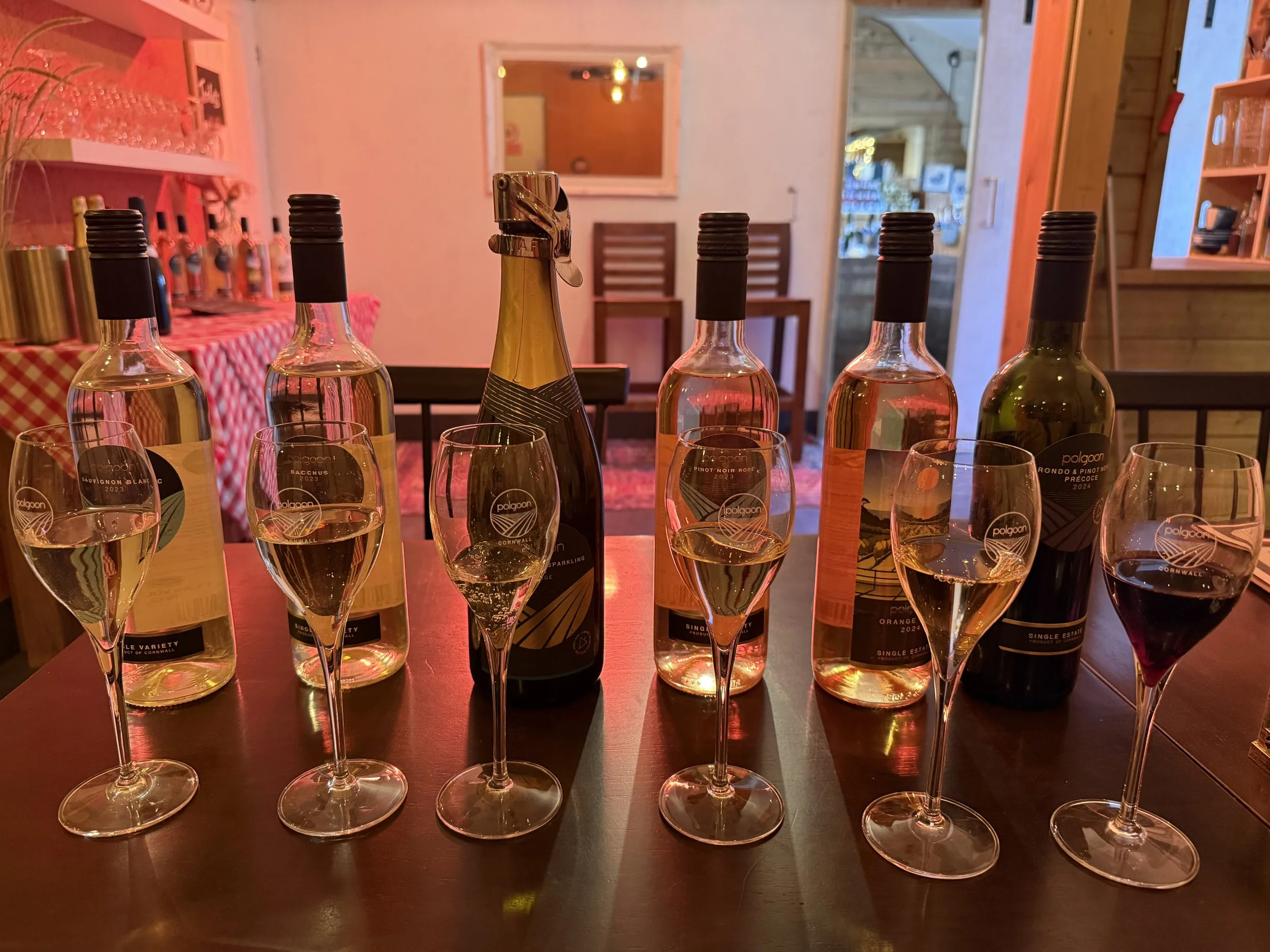
The line-up, from Sauvignon Blanc to the Rondo & Pinot Noir Précoce.
Sauvignon Blanc 2023. Made the conventional way, with tropical fruit, balanced acidity and that coastal salinity. It is the estate's second-best seller, and John made sure it was on my list.
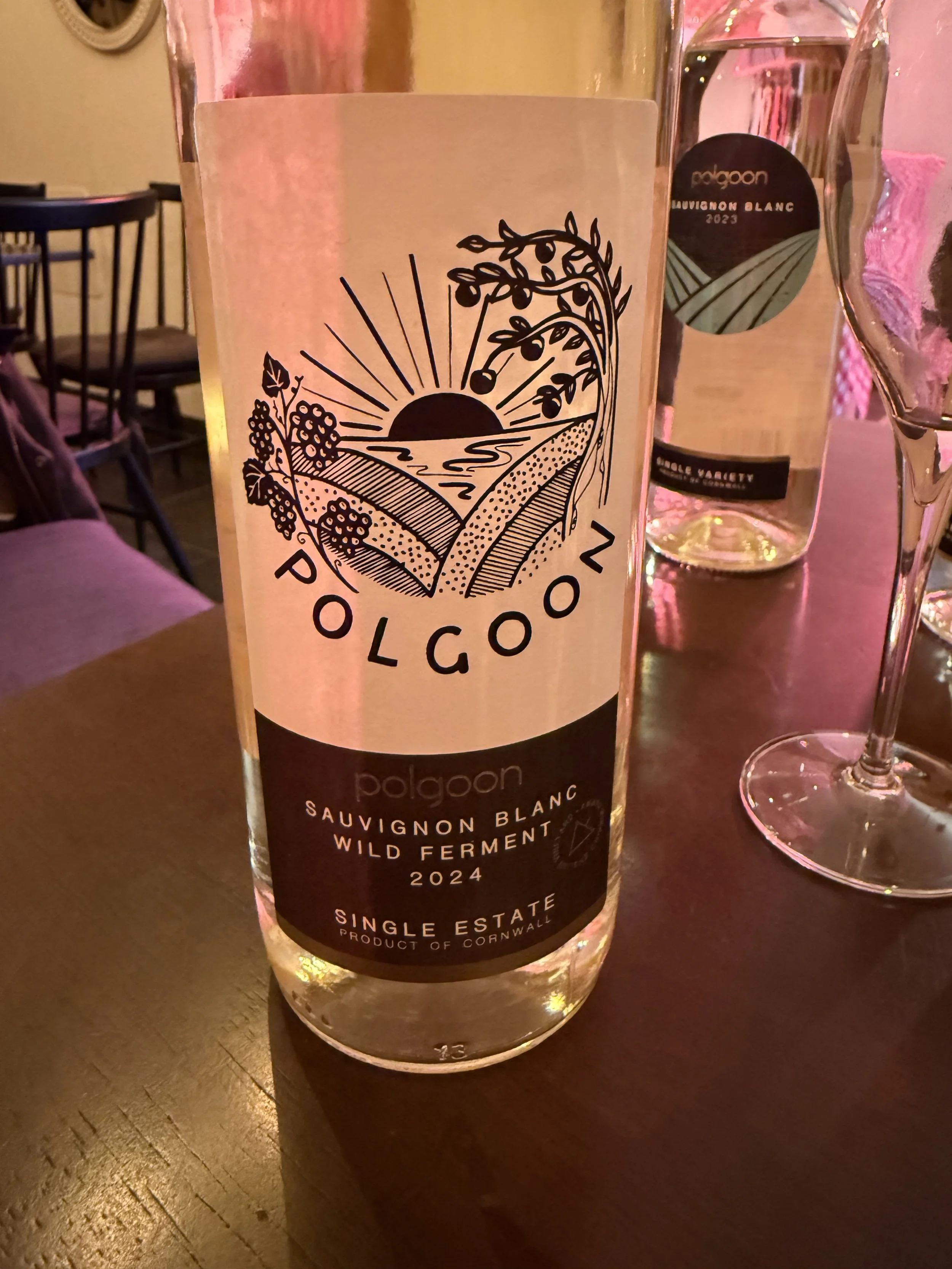
Sauvignon Blanc Wild Ferment 2024. The same grape, fermented with ambient yeast. I loved both Sauvignons, but there was something even more appealing about this one.
Bacchus 2023. Polgoon's best seller and its most awarded wine. Debbie admits it is her favourite, "but it's very close." This is the variety John is defending against the rush to sparkling.
Seyval Blanc Sparkling. Crisp, refreshing and very easy to drink, with lots of freshness and fruit. Debbie points out that Polgoon's sparkling wines have won plenty of awards.
Pinot Noir Rosé 2023. Rose petals and raspberries, with a gentle, almost silky texture. The word I wrote down was "lacy". Debbie says it "dances around your mouth", and that is exactly right.
Orange Wine 2024. Polgoon's first ever orange wine, made from Bacchus with skin contact. Only 900 bottles were made. Tropical notes again, with good length and a long finish.
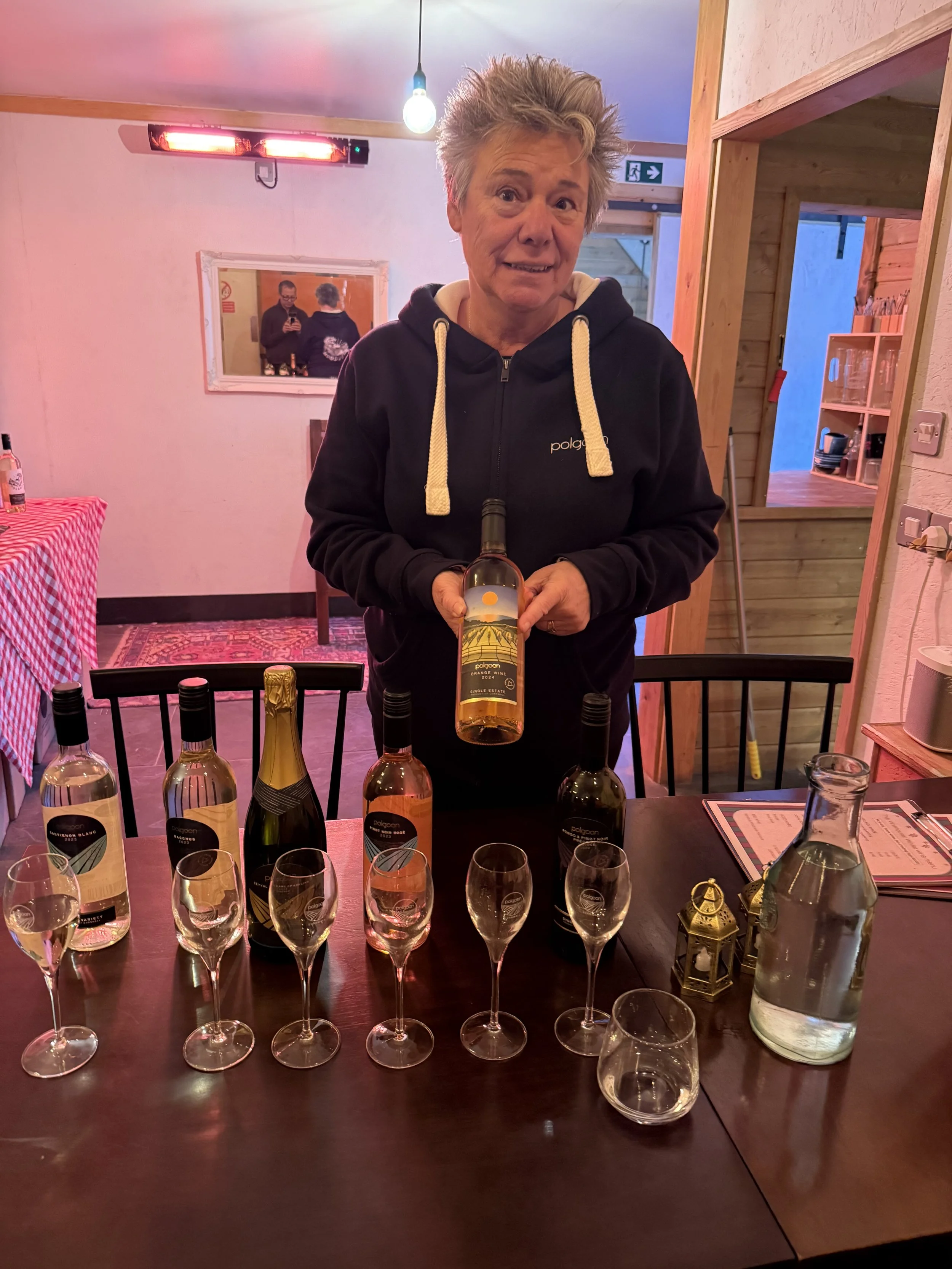
Debbie with the 2024 Orange Wine, one of only 900 bottles.
Rondo & Pinot Noir Précoce 2024. A rich nose of black stone fruit, dried figs, liquorice and a touch of black pepper. The palate is dry and well balanced: proof that Cornwall can make a serious red.
The verdict
Polgoon is worth the trip, and the wines show what west Cornwall can do when the vineyard is protected and the fruit is respected. I told John how impressed I was, and how different the wines are from those I tasted twelve years ago. The tunnels, the stainless steel and the sea air all play a part, but the real story is a grower who trusts his fruit and says what he thinks.
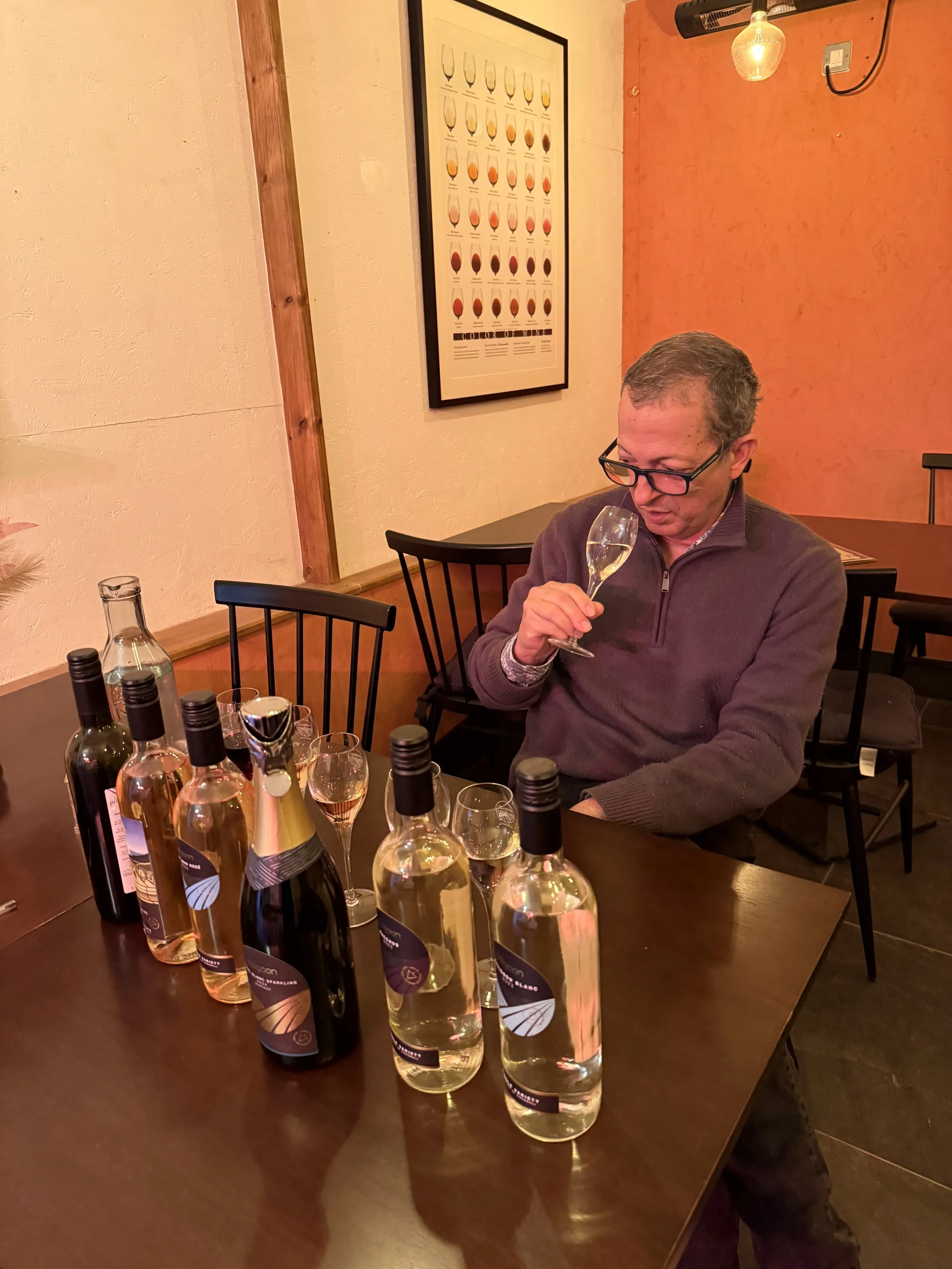
The author at work in the Polgoon tasting room.
If you visit, start with the two Sauvignons side by side. Then buy a bottle of the orange wine while there are still some of the 900 left.
Polgoon Vineyard & Orchard has a shop, tours and a kitchen. The shop offers 10% off mixed cases of six wines.
Carlos Caruncho is a vigneron and independent viticulture and winemaking consultant based in Newlyn, Cornwall.