
Thirty-Three Meters Down: Bodegas Undersea
In Mazarrón, on the Murcian coast, two former underwater contractors are ageing wine 33 metres beneath the Mediterranean, and the results are better than I expected.
A gate in Mazarrón
I reached Mazarrón at ten in the morning on 22 November, as agreed with Miguel. A long iron gate stood closed. I pressed the buzzer, and a few minutes later two smiling faces appeared to let me in: Miguel and his business partner, Gregorio.
The tasting room inside was spacious and calm, done in deep navy with UNDERSEA lettered down one wall. The bottles along the counter looked like nothing you would see on a bar. They were crusted with sand, tufted with marine growth and sealed in thick white wax, and no two were alike. Gregorio handed me a coffee after the long drive from Murcia, the first corks came out, and the conversation began.
I should be honest about how I arrived. Underwater ageing can sound like a story built for marketing, and I half expected a novelty. By the end of the morning, Miguel and Gregorio had made a believer of me.
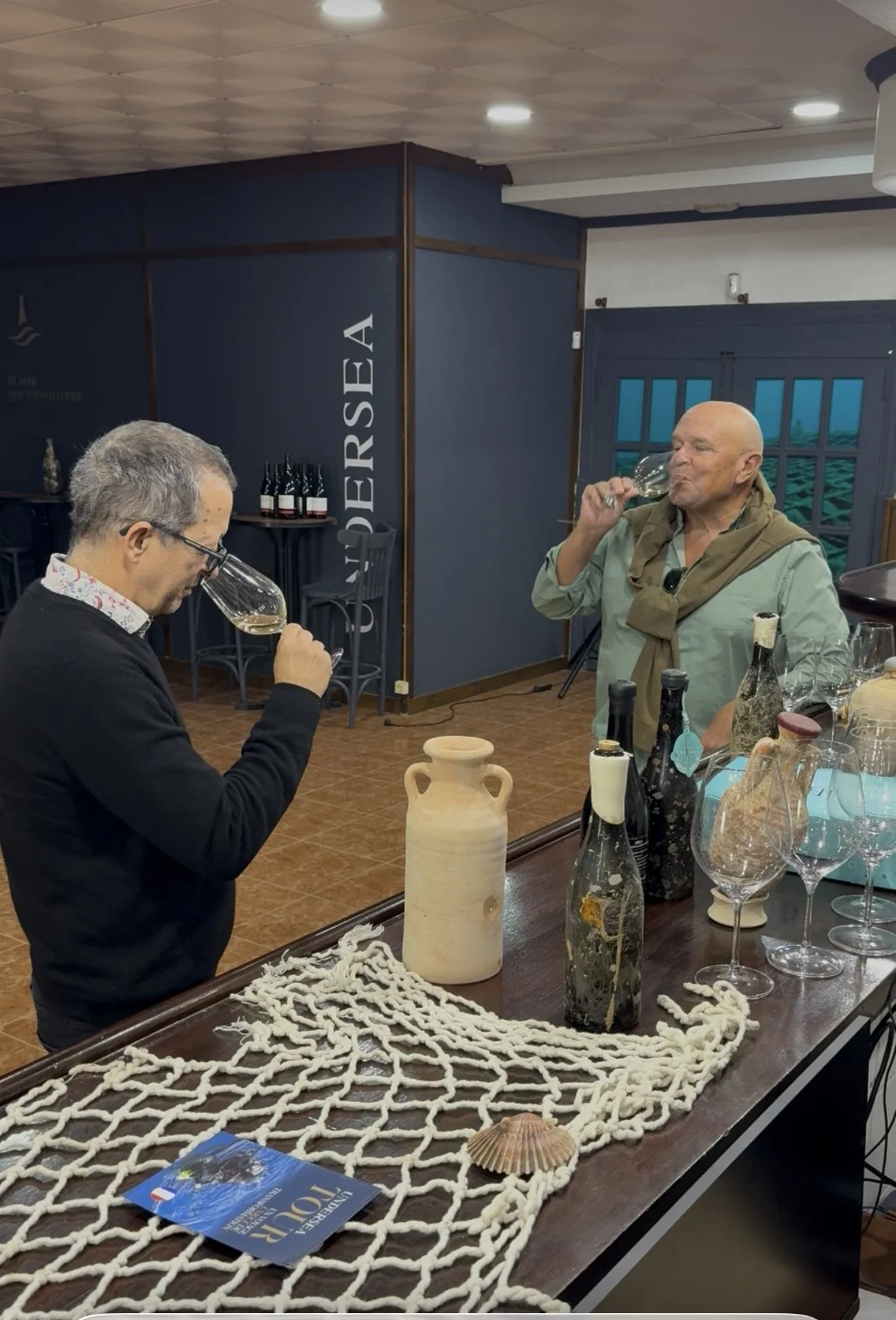
First pours with Miguel in the Undersea tasting room in Mazarrón.
Divers first, winemakers second
Undersea did not start out as a wine company. It started in underwater engineering, doing marine works along the Murcian coast with boats, cranes and divers. That history is its quiet advantage. Most people who try to age wine under the sea have to hire all of that. Undersea already owned it and used it every day.
Ageing wine began as a sideline to that work. It has since become the priority. The subsea contracting continues and pays well, but Miguel and Gregorio see the bigger opportunity in wine, and above all in premium wine. By their figures, premium wine is about ten per cent of the market by volume but about thirty per cent by value.
The team is small: winemakers, divers, engineers and people who simply love wine. In April 2024 they opened what was billed as Europe's largest underwater wine cellar, in the Mediterranean off the Cartagena coast. It can hold up to five million bottles.
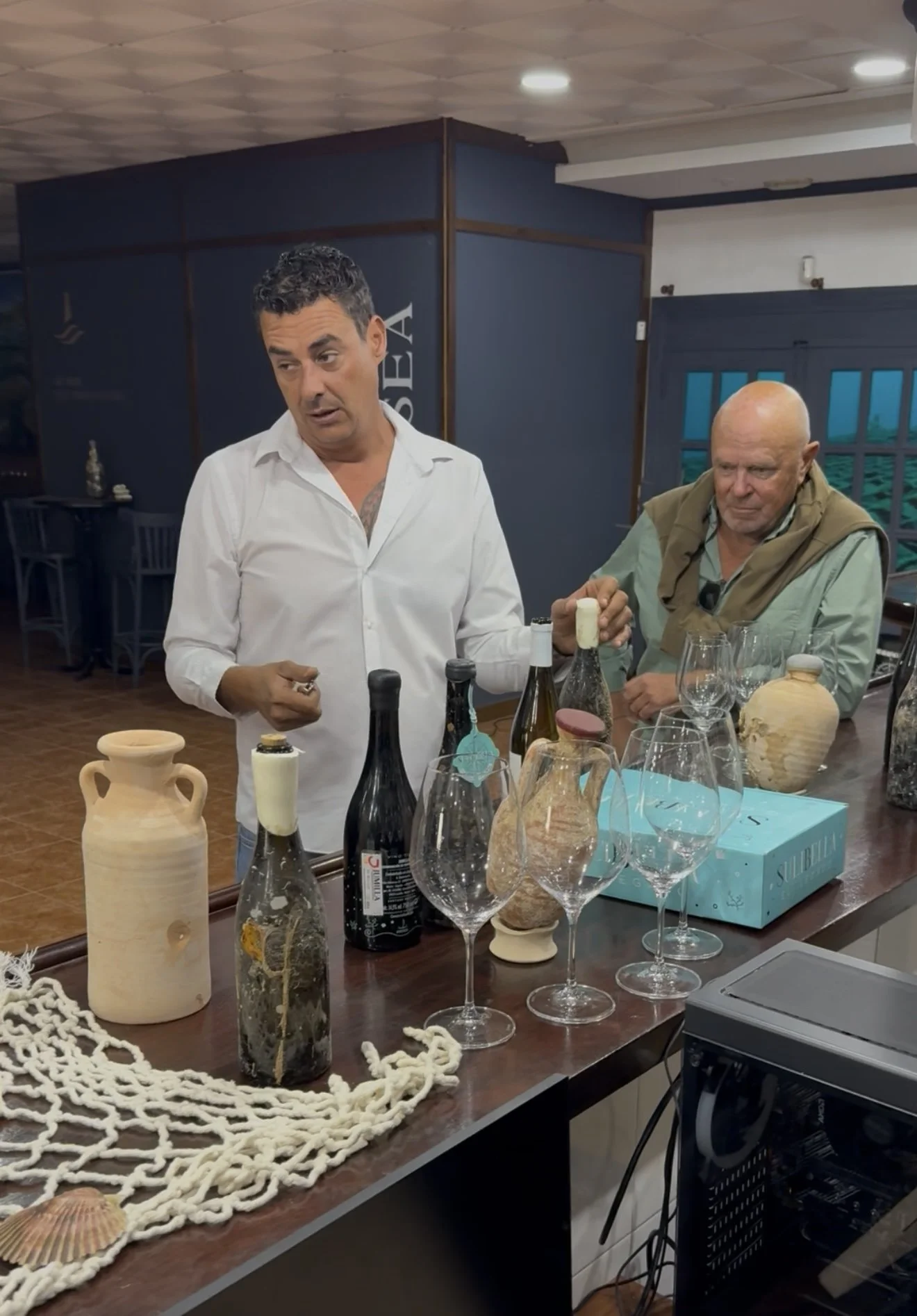
Gregorio walks through the process, with Miguel beside him and the sea-aged bottles lined up on the counter.
How the sea does its work
The bottles rest on the seabed at about 33 metres. Whites stay down for six to eight months and reds for ten to twelve. The Sulibella red I tasted had spent a full year below; the white had spent six months.
Research by several universities points to a few reasons the wine changes down there: steady temperature, pressure, darkness and humidity. Movement matters most. A bottle that weighs 1.8 kg on land weighs about 0.2 kg on the seabed, so it never sits still. It sways with the current like a slow dance, around the clock, for months. Gregorio reaches for James Bond's martini to explain it: neither shaken nor stirred, just gently rocked, twenty-four hours a day, seven days a week.
Each bottle is sealed with a thick cap of high-quality synthetic wax to keep the sea out. When a bottle comes up, the first check is the cork, which should be completely dry. Every one I saw opened was. Marine life grows freely on the glass, shaped by how long the bottle stayed down, where it lay and the season. As they put it, every bottle carries its own map.
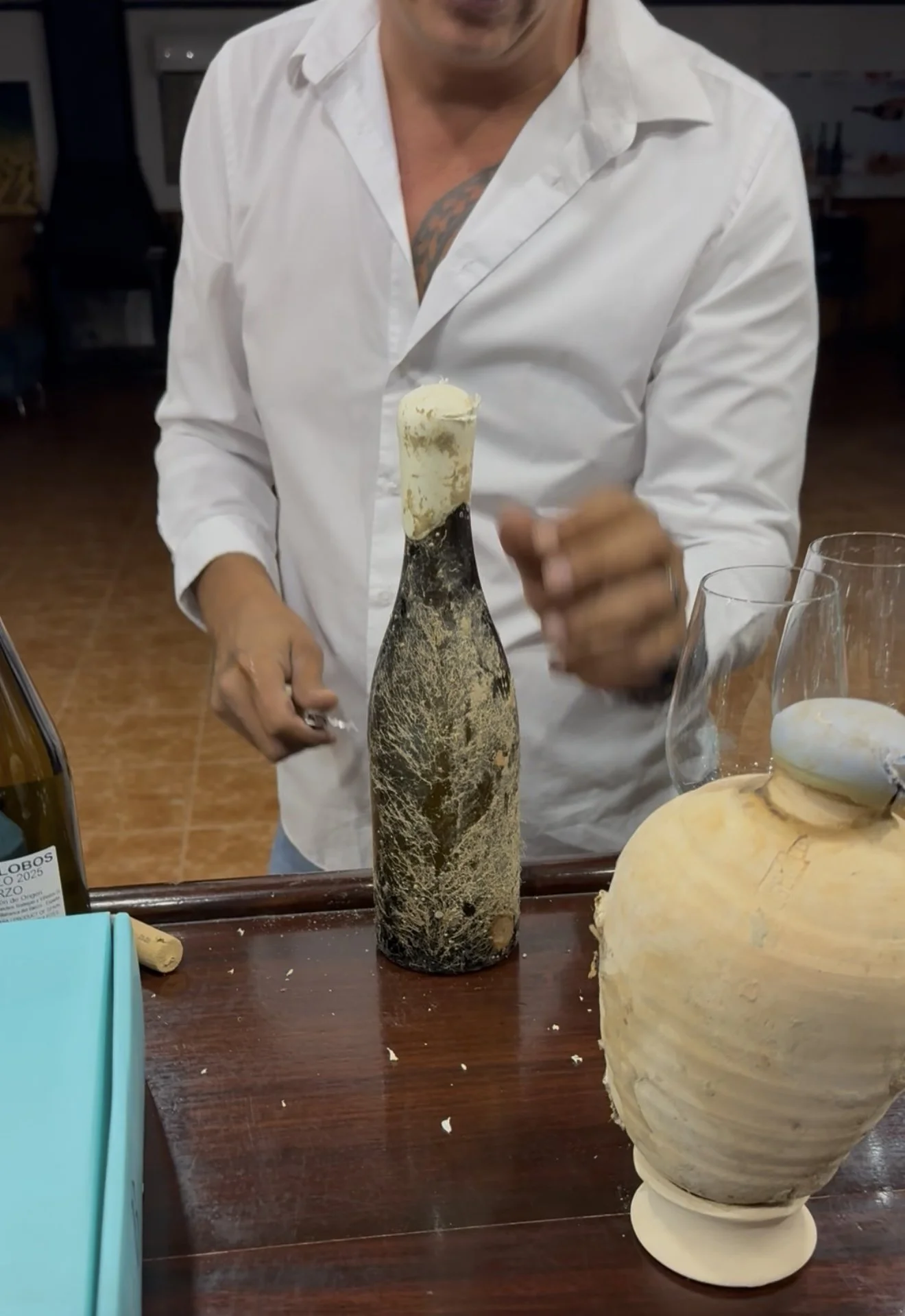
Gregorio cuts through the synthetic wax on a bottle back from 33 metres.
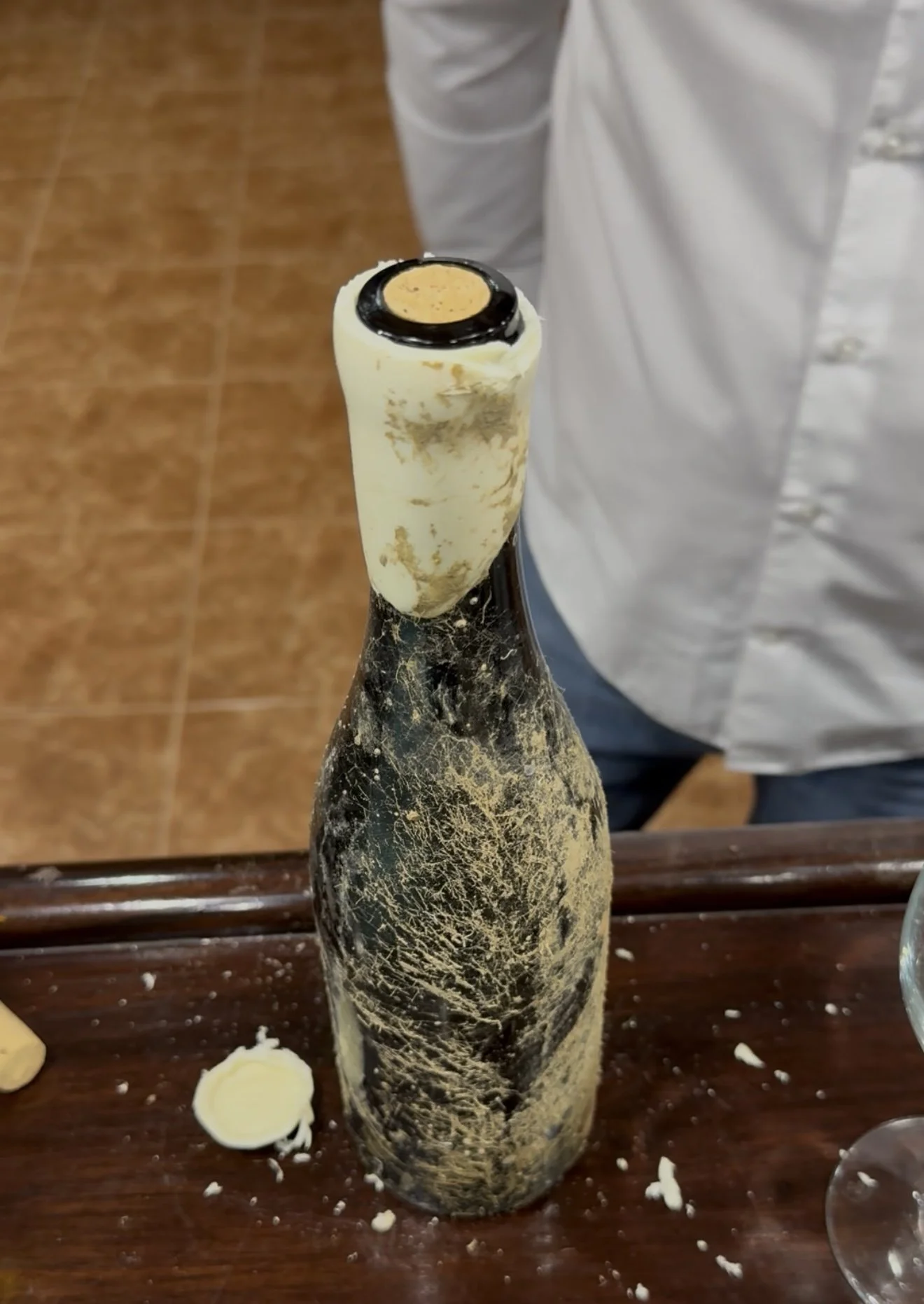
The moment of truth: the cork beneath the wax, perfectly dry.
Land against sea
An Undersea tasting is built on side-by-side pairs. The same wine is poured twice: once from the bottle kept on land, which they call the testigo (the witness), and once from its twin that spent months on the seabed. We tasted five wines:
D'Brisa, a Godello from El Bierzo, land and sea versions
Sulibella El Legado, their red, land and sea versions
A sparkling wine that has not yet been down
The difference between land and sea was night and day. In every pair, the sea version was smoother, rounder and more beautiful.
The red showed it most clearly. Sulibella is a Jumilla wine: 92% Monastrell, 4% Syrah and 4% Cabernet Sauvignon. On land it is powerful and structured, with the firm grip Monastrell is known for. After a year below it came up rounder and velvety. They compare the change to the palate of a Ribera del Duero. The tannins change measurably, and they have the lab figures. But as they rightly say, a guest doesn't need percentages. A guest needs the two glasses side by side.
The sparkling wine was the surprise of the morning. It was superb before it had ever touched the sea, and I want to taste it when it comes back up.
One detail says a lot about how this team works. The testigo bottle had been filtered, while its sea twin went down with yeast still in it. Gregorio explained that they use every immersion to run more trials, sending wine down on its lees or with particular yeasts to see how it develops. Ageing is half of what they do. Research is the other half.
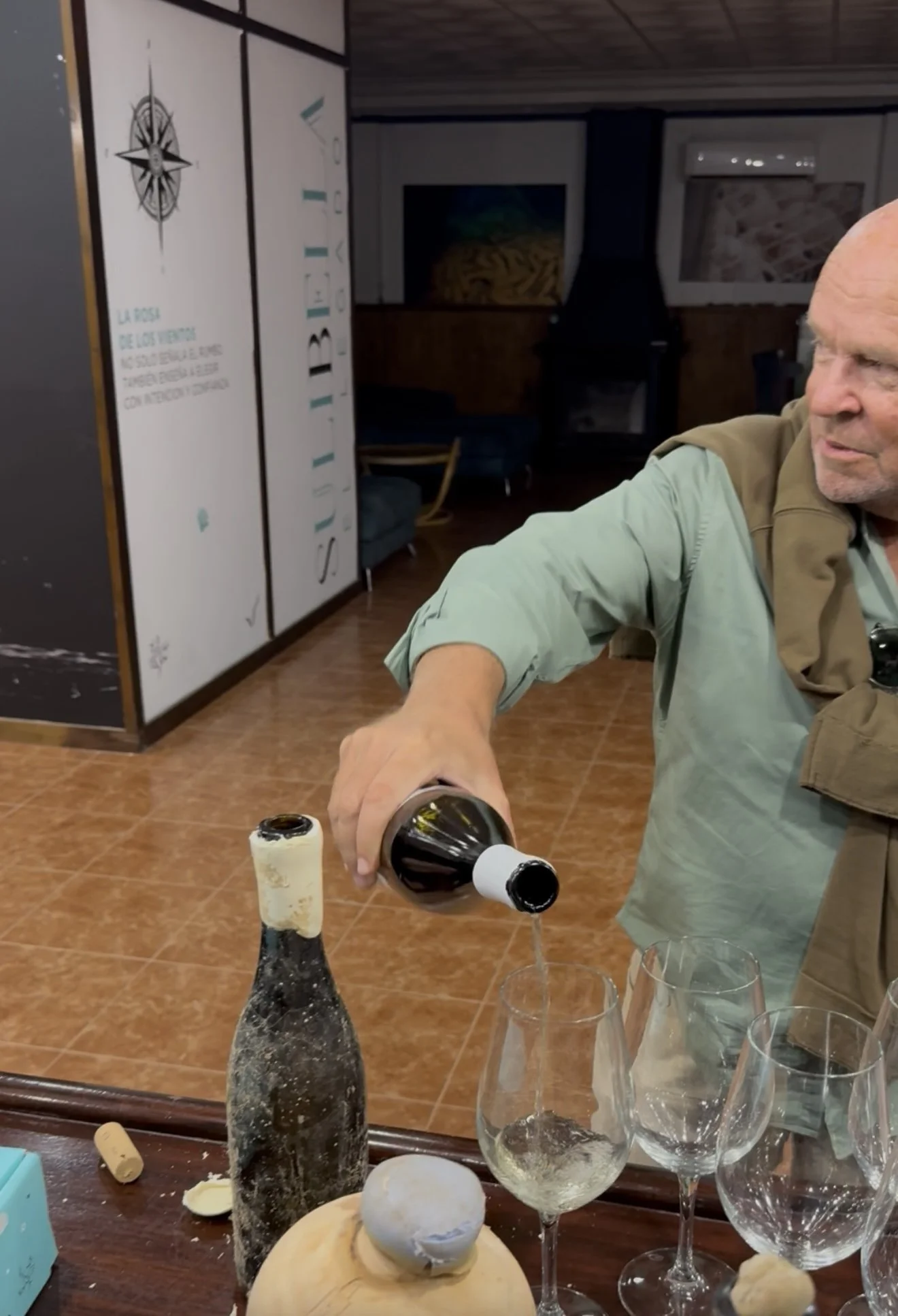
Miguel pours the land-aged D'Brisa Godello beside its twin from the seabed.
Sulibella, and a service for other wineries
Undersea's business runs on two tracks. The first is Sulibella, the house brand and flagship, which covers reds, whites and sparkling wines. The second, and the larger share of the business, is a service for other wineries. Undersea ages their wines under the sea and returns both versions, the testigo and the sea-aged bottle, for the client to sell.
"We can age any wine and any grape," they told me. Right now that means Monastrell from Jumilla, Godello from El Bierzo, a Tempranillo from the Valencia area and trials with sparkling wine. For a producer, it is a way to offer a distinctive, limited release without building any of the infrastructure.
Visitors can taste the difference for themselves. In Puerto de Mazarrón there is a 90-minute comparative tasting, paired with Murcian products, from €65. In Cartagena there is a tasting on a catamaran, from €95.
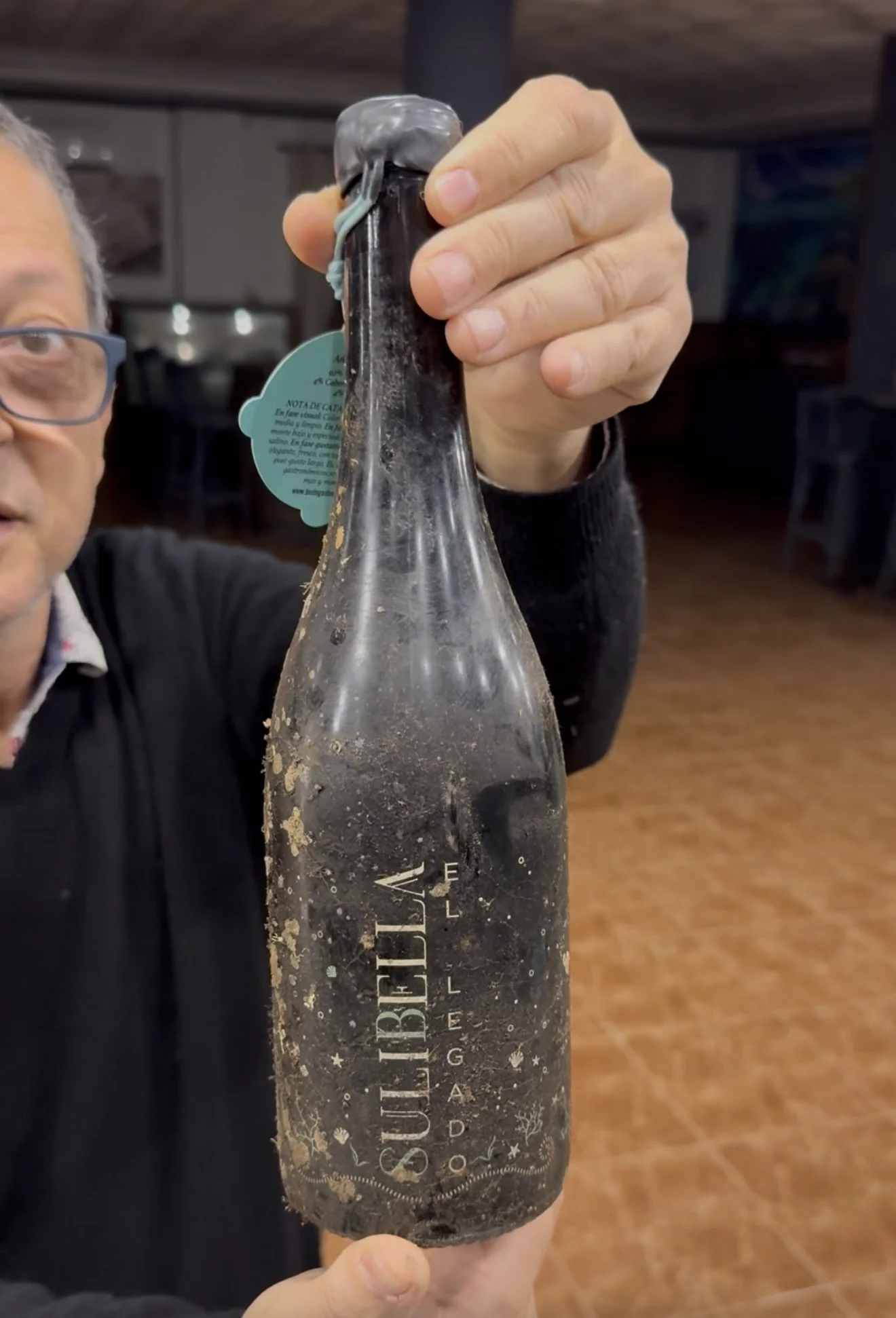
Sulibella El Legado, Monastrell from Jumilla, after a year under the Mediterranean.
The next question: how long is long enough?
For me, this is where Undersea gets really interesting. They currently age most wines for eight or nine months. They will tell you plainly that nobody yet knows where the ceiling is. Some producers keep wine down for much longer, and the right length depends on the wine you want to make.
Miguel and Gregorio would rather measure than guess, so they are starting a second study with the agronomy department of the Universidad Politécnica de Cartagena. It will test wines at eight, nine, ten, eleven, twelve, fourteen and twenty months. The question is whether the wine keeps improving, levels off, or starts to lose something. Alongside that study they continue the lees and yeast trials, new grape varieties and sparkling wine.
That is a rare attitude in a category that could easily coast on novelty. Undersea treats the sea as a variable to understand, not a gimmick to sell.
Why I'll be back
I spent about ten years in low-intervention cellars in California, and the questions Undersea is asking are the ones I care about most. What happens to an unfiltered wine resting on its lees when it never stops moving? How does a lightly handled base wine respond to months at depth? Where does the curve level off for a white, a red or a sparkling wine?
None of those can be answered by one person alone. They need producers, scientists and winemakers tasting together and writing things down. Miguel and Gregorio have already built the hardest part: the boats, the divers, the cellar and the habit of testing everything. I left Mazarrón with a notebook full of experiments I would like to run with them, and a strong feeling that the best bottles from this coast are still on the seabed.
If you are anywhere near Murcia, book the tasting, ask for the two glasses side by side, and taste the difference yourself.
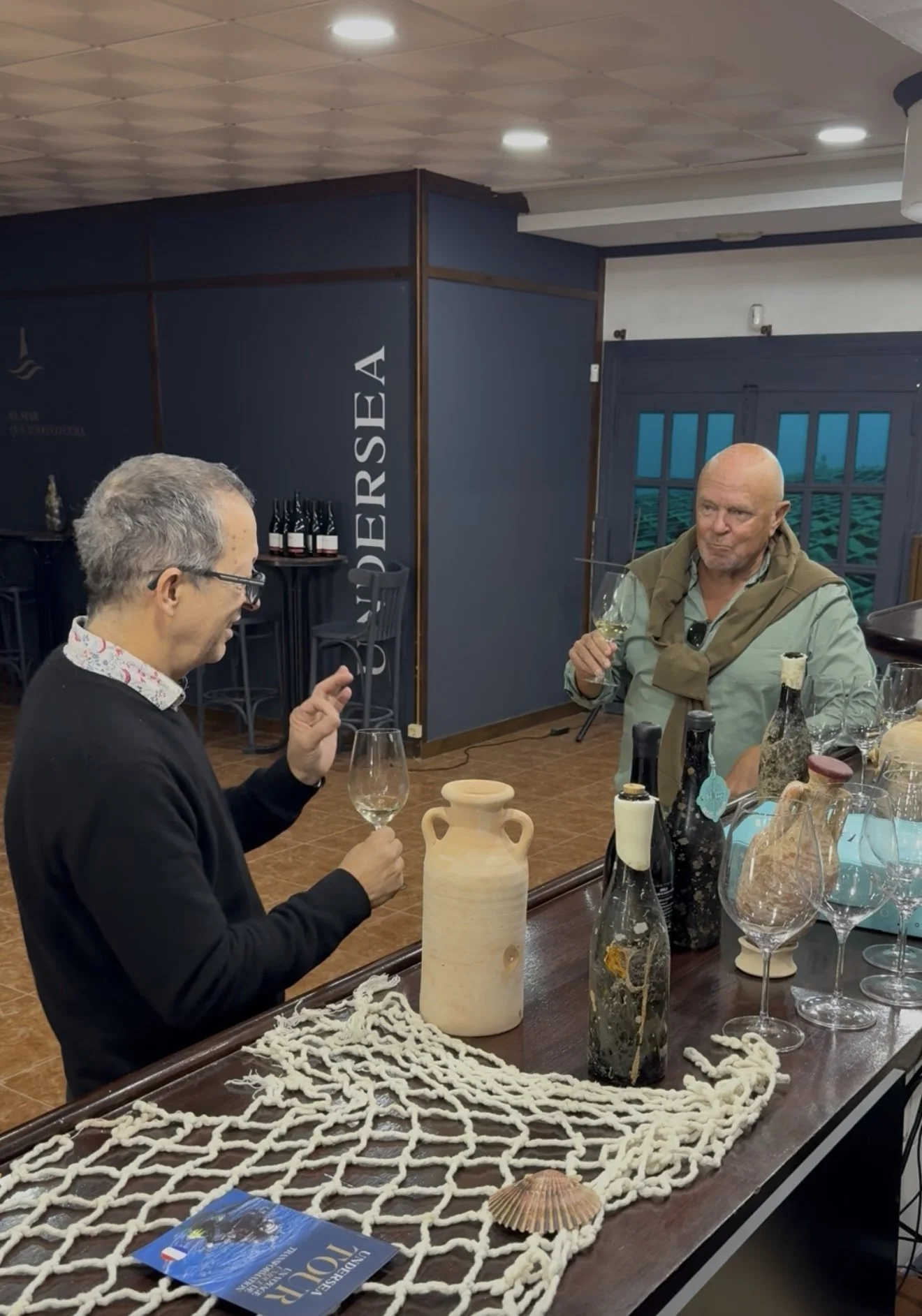
Comparing notes with Miguel. It's a conversation I hope continues.
Sources
Murcia Today: largest underwater wine cellar in Europe opens in Cartagena
https://m.murciatoday.com/biggest-underwater-wine-cellar-in-europe-to-be-located-in-cartagena_1000035932-a.html
Winedering: Wine tasting in Puerto de Mazarrón, Bodegas Undersea
https://www.winedering.com/wine-testing-in-puerto-de-mazarron_d9099_travel
Winedering: Catamaran tasting in Cartagena
https://www.winedering.com/es/on-board-tasting_d8588_travel