
Four Châteaux, One Question: Bordeaux and the Changing Climate
I asked the same question at four of Bordeaux's great estates: how are you preparing your vineyards for a changing climate? Each estate answered in its own way, from a fully worked-out biodynamic strategy to decades of quiet research, and together they say as much about Bordeaux today as any wine we tasted.
On 13 and 14 October 2026, my wife Eliza, our friends Brian and Laura, and I spent two days between the Left Bank and the Right: Château Palmer and Château Margaux in the Médoc, then Château Figeac and Château Tertre Rôtebœuf in Saint-Émilion. I went as a vigneron and consultant, notebook in hand, to see what these estates are doing well in the vineyard and cellar, and where the next decade will test them.
Château Palmer, Margaux: a vineyard farmed like a garden
Palmer was the most complete answer to my question. Technical Director Sabrina Pernet is already acting on climate change on several fronts at once.
The estate. Palmer is a Third Growth of 1855, named after Major-General Charles Palmer, who bought the vineyards in 1814. Since 2004 it has been run by Thomas Duroux, and it is one of the boldest classed growths in Bordeaux (Château Palmer). Duroux and Pernet stopped chemical treatments in 2007, began biodynamic trials on two hectares in 2008, farmed the whole estate biodynamically from 2014, and gained Demeter certification in 2017 (Wine Business International; Decanter). Palmer even released a 2014 made with no added sulphur during winemaking (The Drinks Business).
The welcome. The grounds are beautifully kept. The chef, busy preparing lunch for staff and guests, broke off to fetch Sabrina for us. I warned her I had a lot of questions; she welcomed every one. Palmer describes her as treating each plot like a precious garden, and that is exactly how she talks (Château Palmer).
Climate adaptation in practice. Sabrina listed concrete measures:
Trialling new rootstocks that tolerate heat and drought better
Irrigating young vines for their first three years
Considering irrigation for the whole vineyard in the foreseeable future
Rolling cover crops flat instead of mowing them, to protect soil moisture
Several picking passes at harvest, taking only the best fruit
"Drought is not the only problem we have," she told us. August hail, rain before harvest, mildew, and wild boar and other animals eating the spring buds are all part of the fight.
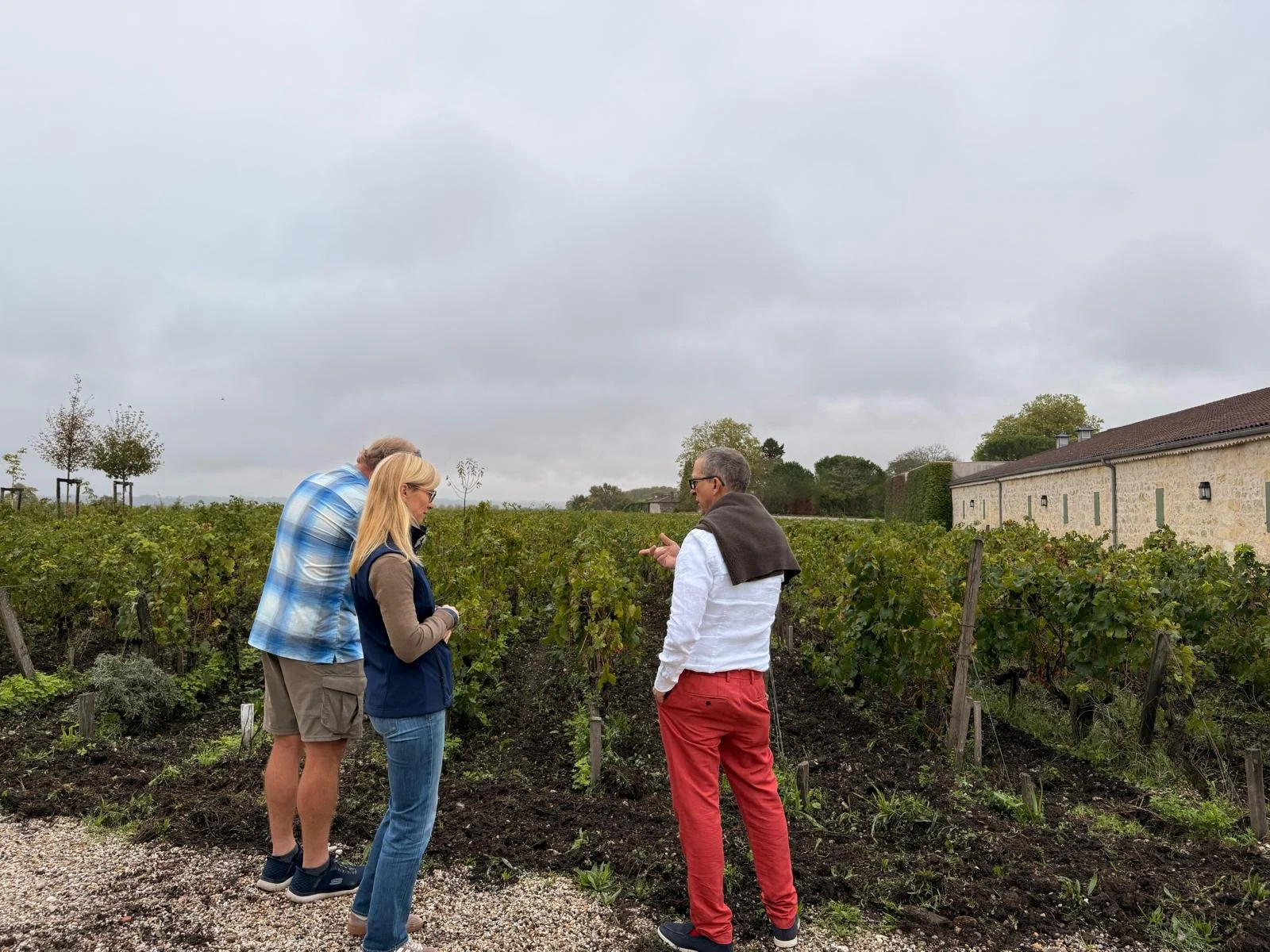
Out in Palmer's vineyard, beside the estate's stone buildings.
Biodynamics up close. In a barn she showed us the dried flowers and herbs for the preparations, and the horn manure (preparation 500). I asked her to explain to the group why cow horns are used rather than bull's horns, and she did so clearly and correctly. All four of us were struck by the team's dedication.
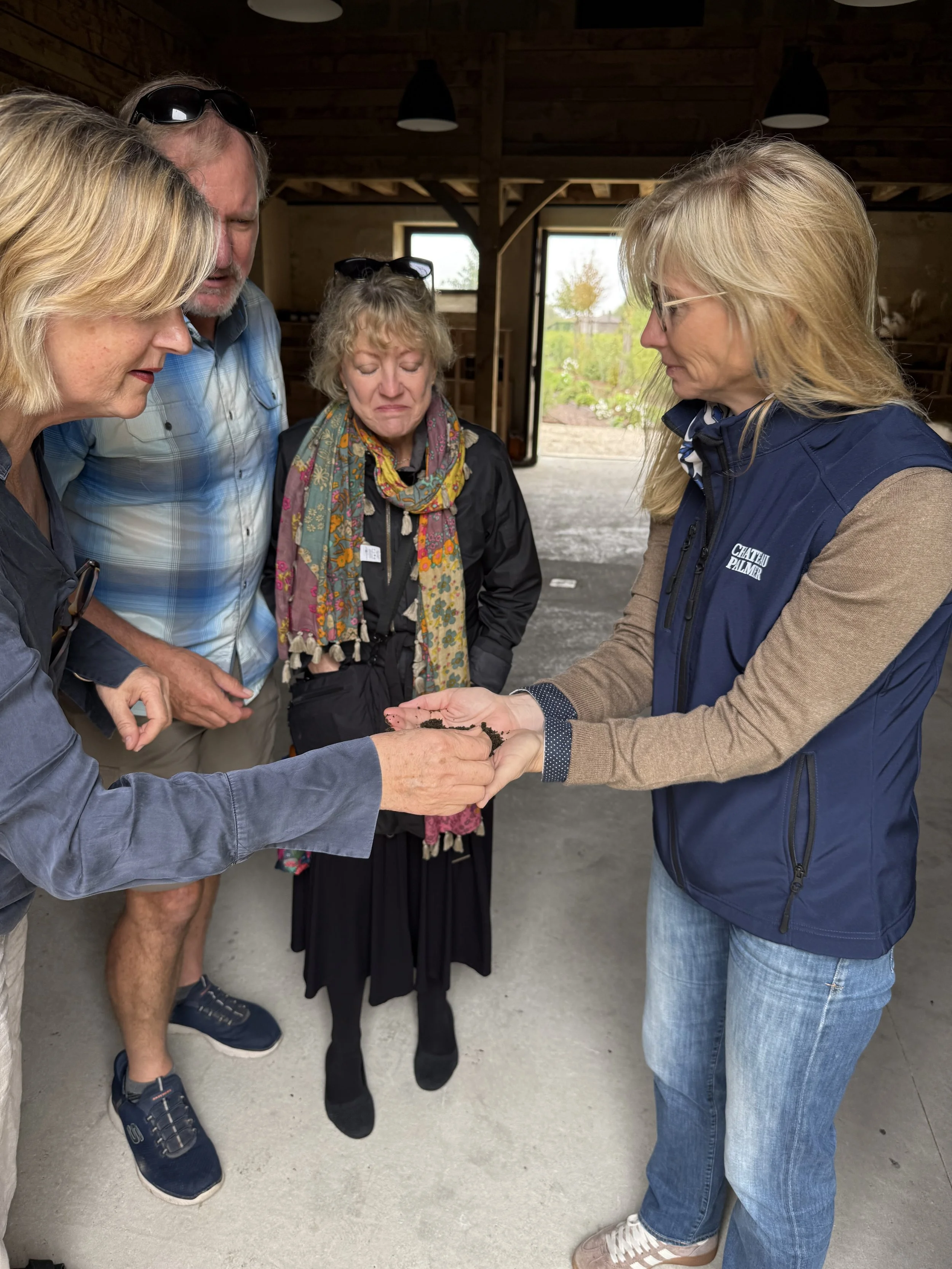
Sabrina Pernet shows us horn manure (preparation 500) in Palmer's biodynamic barn.
Cellar and tasting. In the barrel cellar two young interns, one from Pamplona and one from Georgia, were topping up barrels with wine of the same vintage. Palmer regularly hosts students. We tasted at a table in the middle of the cellar:
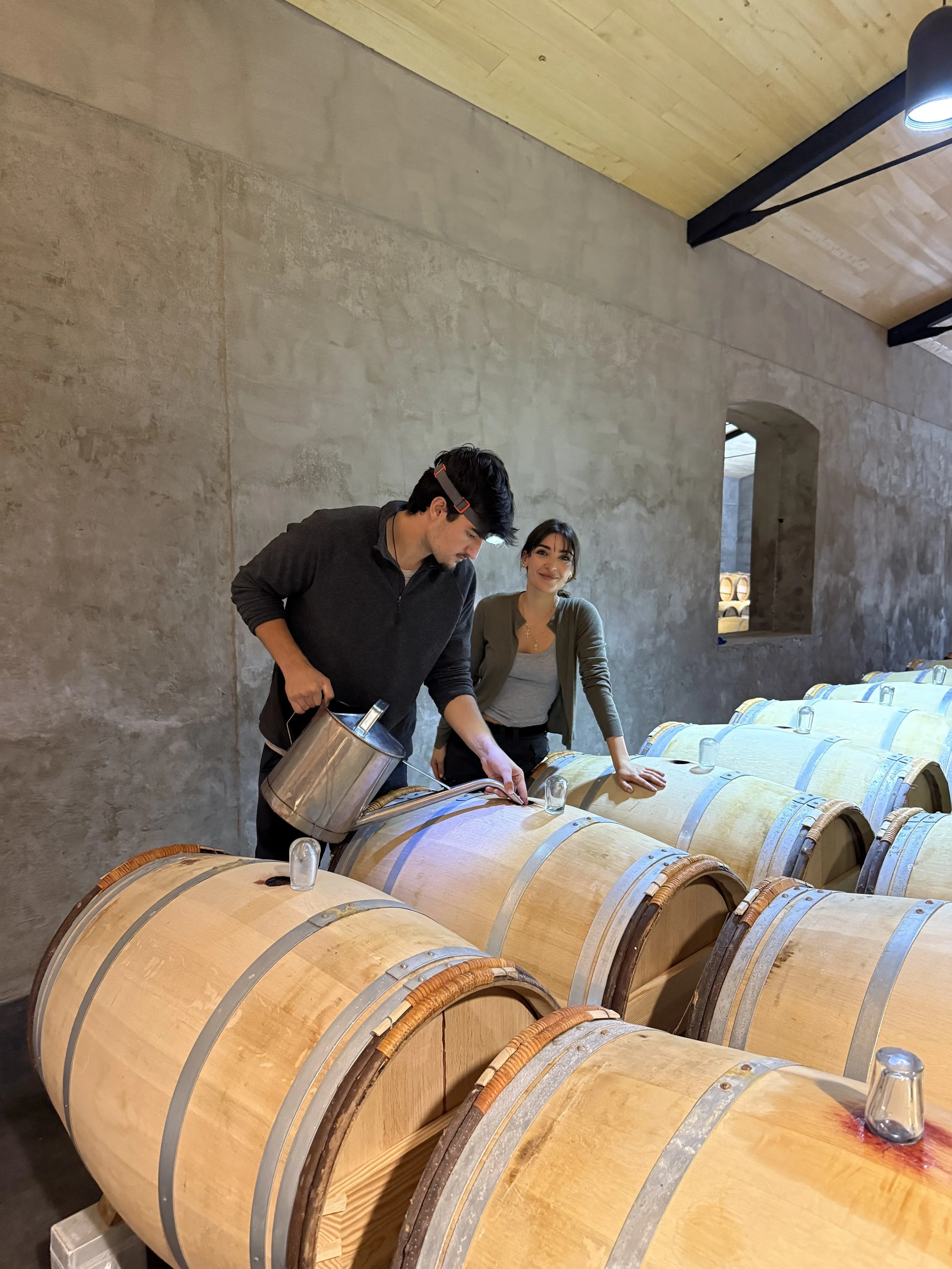
Interns topping up barrels with wine of the same vintage.
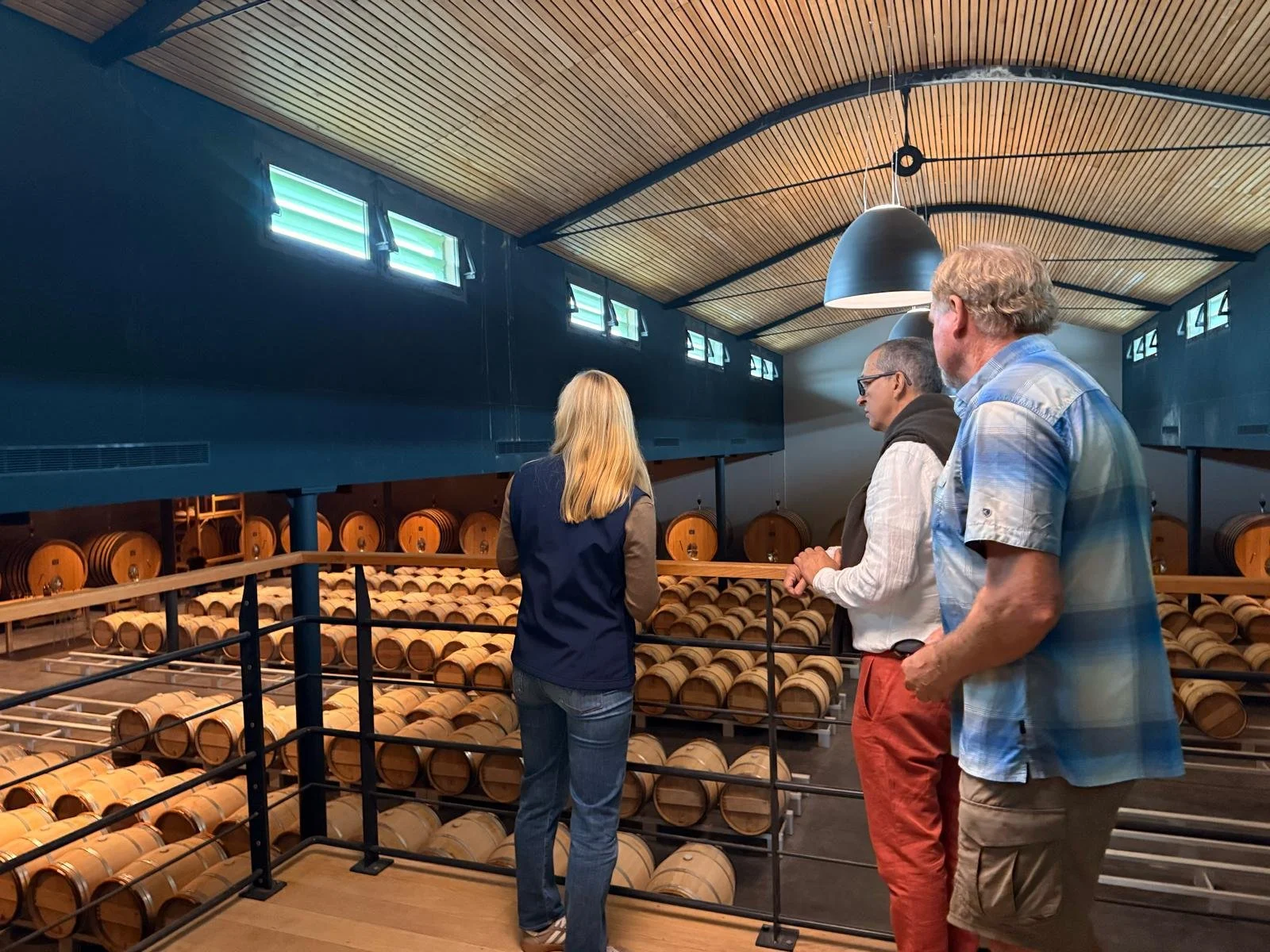
Looking down over Palmer's barrel hall from the mezzanine.
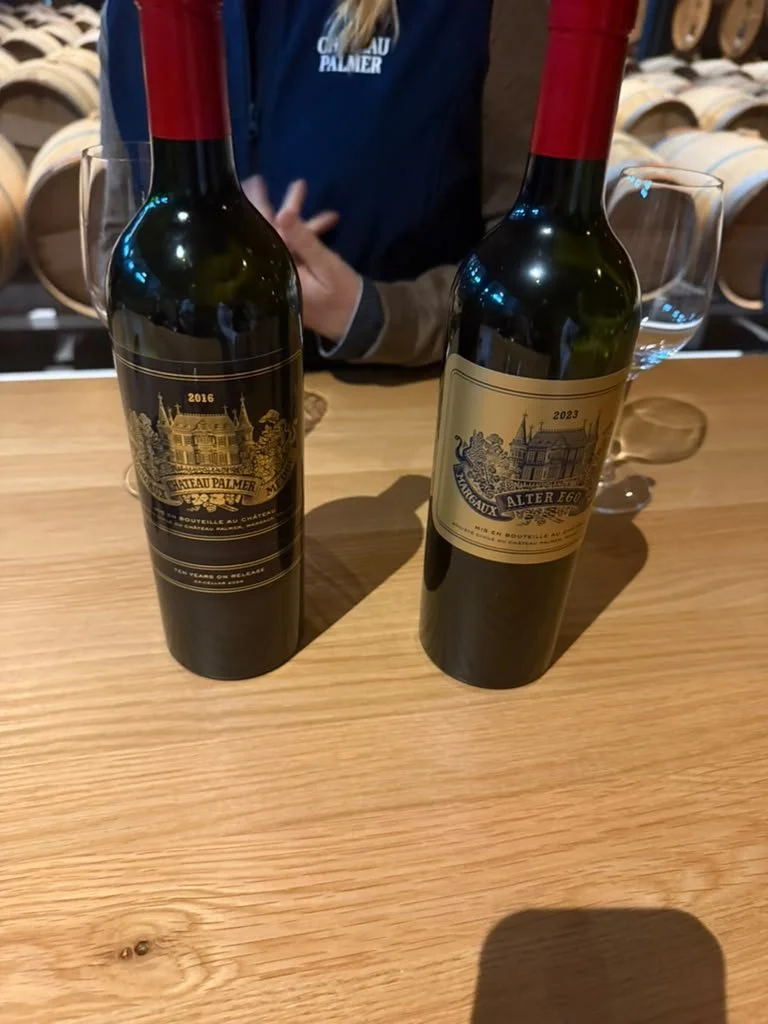
Alter Ego 2023 — the estate's second wine
Château Palmer 2016 — the grand vin
The tasting in the barrel cellar: Château Palmer 2016 and Alter Ego 2023.
Both were outstanding, and you could taste the work done in the vineyard. Lunch followed in the dining room alongside staff and other visitors, hosted warmly by Olivier: a salad, then a wild boar stew with potatoes. Brian loved the 2016 so much we ordered a bottle. The visit surpassed our expectations.
Château Margaux: a First Growth with a long view
At Margaux, climate adaptation is less a talking point than a long-running research programme.
The drive. By midday the morning mist had lifted over the vineyards. The lanes are narrow and shared with tractors, and our GPS sent us astray more than once. I had hoped to arrive down the famous avenue of plane trees; instead we came in from the side and parked by the offices. The reception, a barn-like building with ancient ceiling beams, set the tone.
The estate. Margaux is one of the five First Growths of 1855, owned by the Mentzelopoulos family since 1977. Corinne Mentzelopoulos led it for over four decades; her son Alexis Leven-Mentzelopoulos now runs it day to day, and her daughter Alexandra Petit-Mentzelopoulos chairs the supervisory board (Decanter). The grand vin is built on Cabernet Sauvignon, around 90% of the blend in 2019 (Château Margaux).
The visit. Our hostess Clara was warm and generous with her time. She walked us to the iron gates of the château itself, then through the cellars and production rooms to the family reserve, where we tasted:
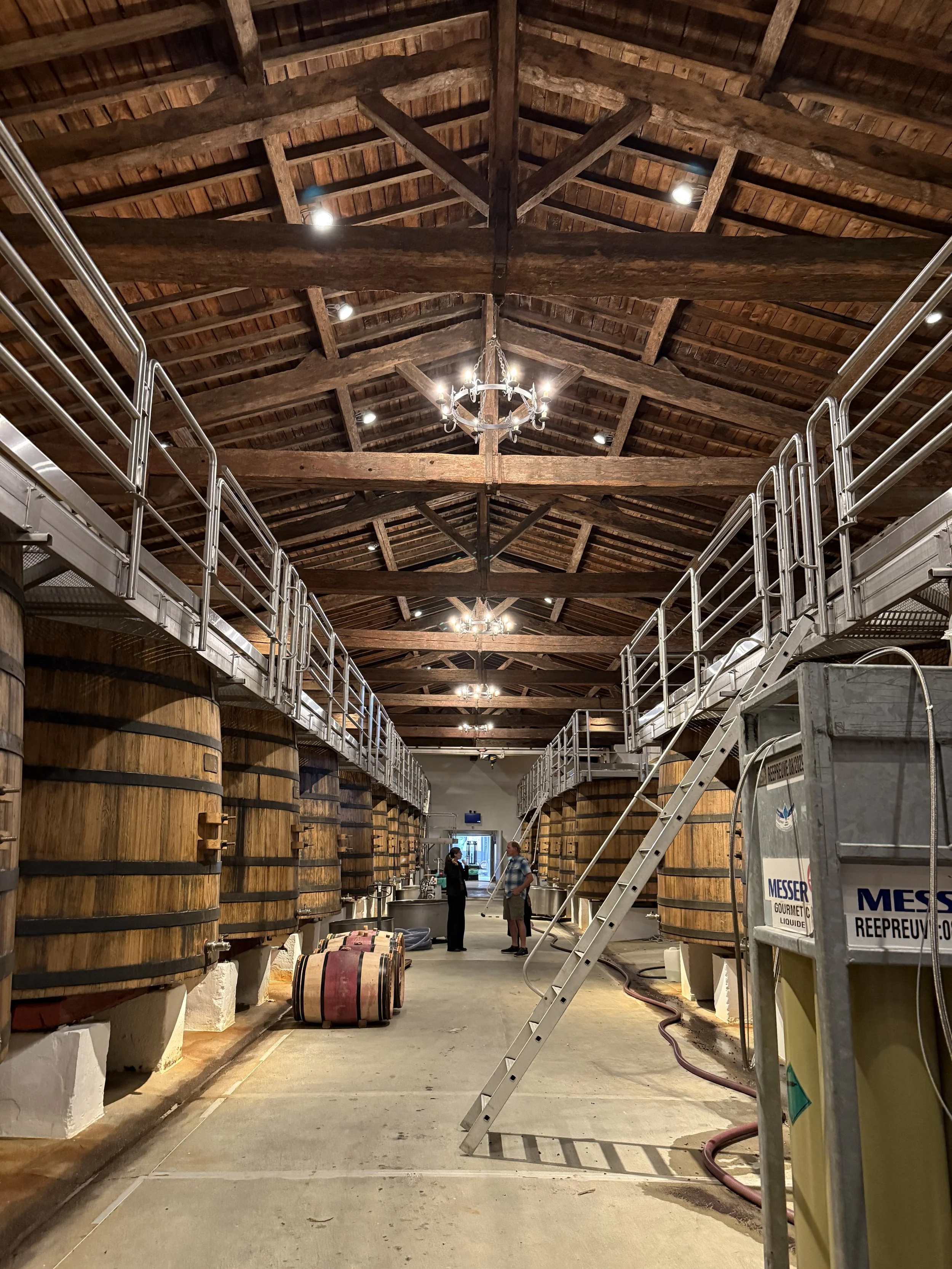
Margaux's oak vat hall, under centuries-old roof timbers.
Pavillon Rouge 2021 — the second wine
Château Margaux 2018 — the grand vin
Both held up beautifully side by side.
The answer. When I asked about climate change, Clara told us the estate had not faced serious problems so far. Behind that calm, Margaux has been working on the question for a long time: Margaux has run its own research and development department since 1999, and adapting to climate change is one of its three priorities, covering water stress, ripening cycles, rootstocks, clones and massal selections (Château Margaux R&D; Château Margaux). Even in 2019, Margaux recorded 39.9°C in a July heatwave (Château Margaux).
The farming is changing too. Margaux has been converting to organic viticulture for several years, and 2026 will be its first certified organic vintage. A small part of the vineyard has long been farmed biodynamically on a trial basis, with the team recording the results (Château Margaux, correspondence with the author, October 2026).
Margaux's way, it seems, is to do the work quietly in the vineyard and the lab, years before the effects show in the glass.
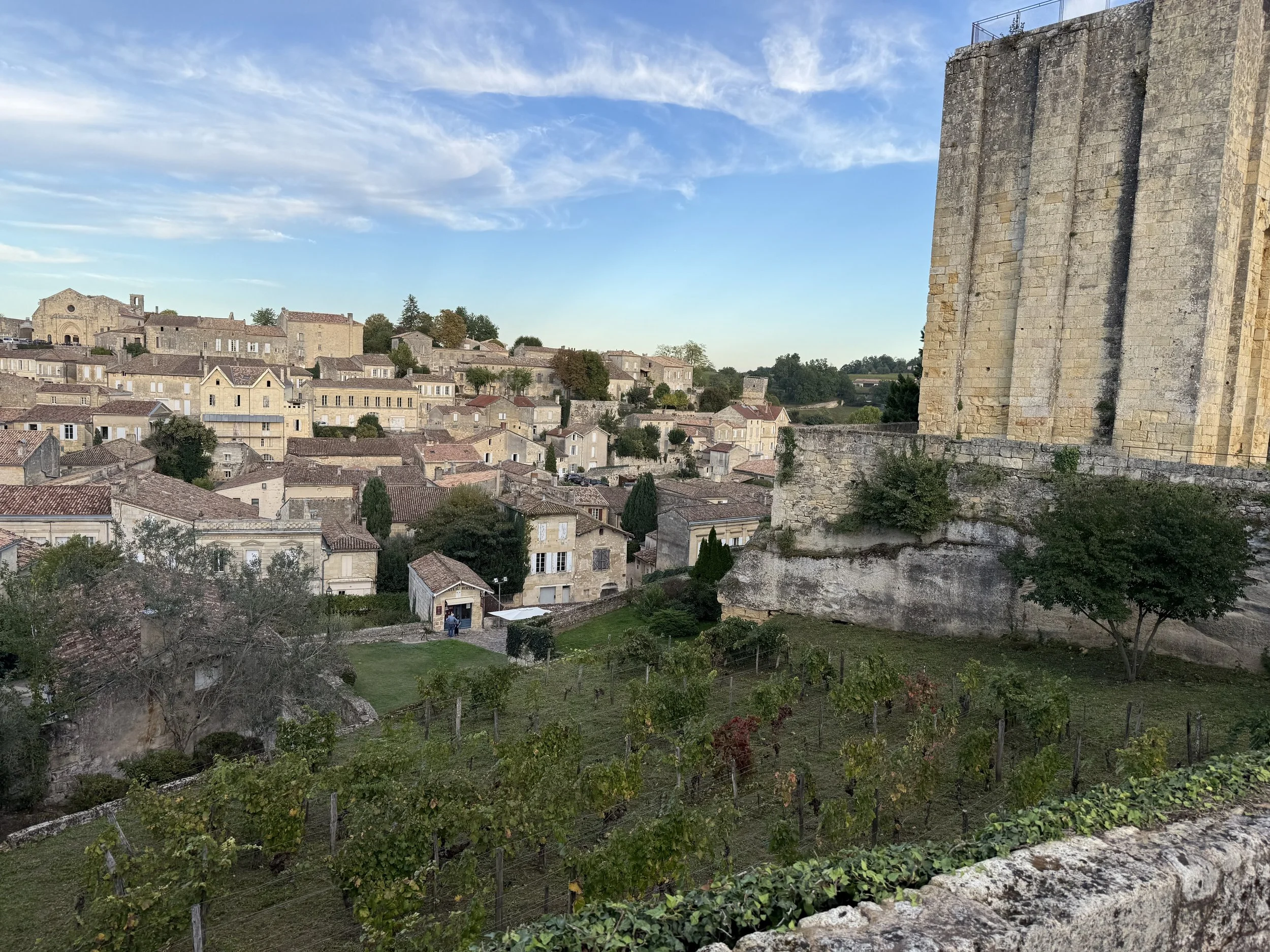
Crossing to the Right Bank: Saint-Émilion and its vines.
Château Figeac, Saint-Émilion: gravel, Cabernet and a new cellar
Figeac is the Right Bank estate that behaves like the Left Bank, and its 2021 second wine was my favourite of the trip.
The estate. Figeac has belonged to the Manoncourt family since 1892 and was promoted to Premier Grand Cru Classé "A" in 2022 (Premium Grands Crus; Decanter). Its 41 hectares sit in one block on three deep gravel rises of flint and quartz over blue clay, unusual for Saint-Émilion (UGCB). That warm, free-draining gravel is why Figeac plants roughly equal thirds of Cabernet Sauvignon, Cabernet Franc and Merlot, where its neighbours are mostly Merlot. Managing Director Frédéric Faye oversaw a new, partly underground winery; 2021 was its first vintage (Decanter).
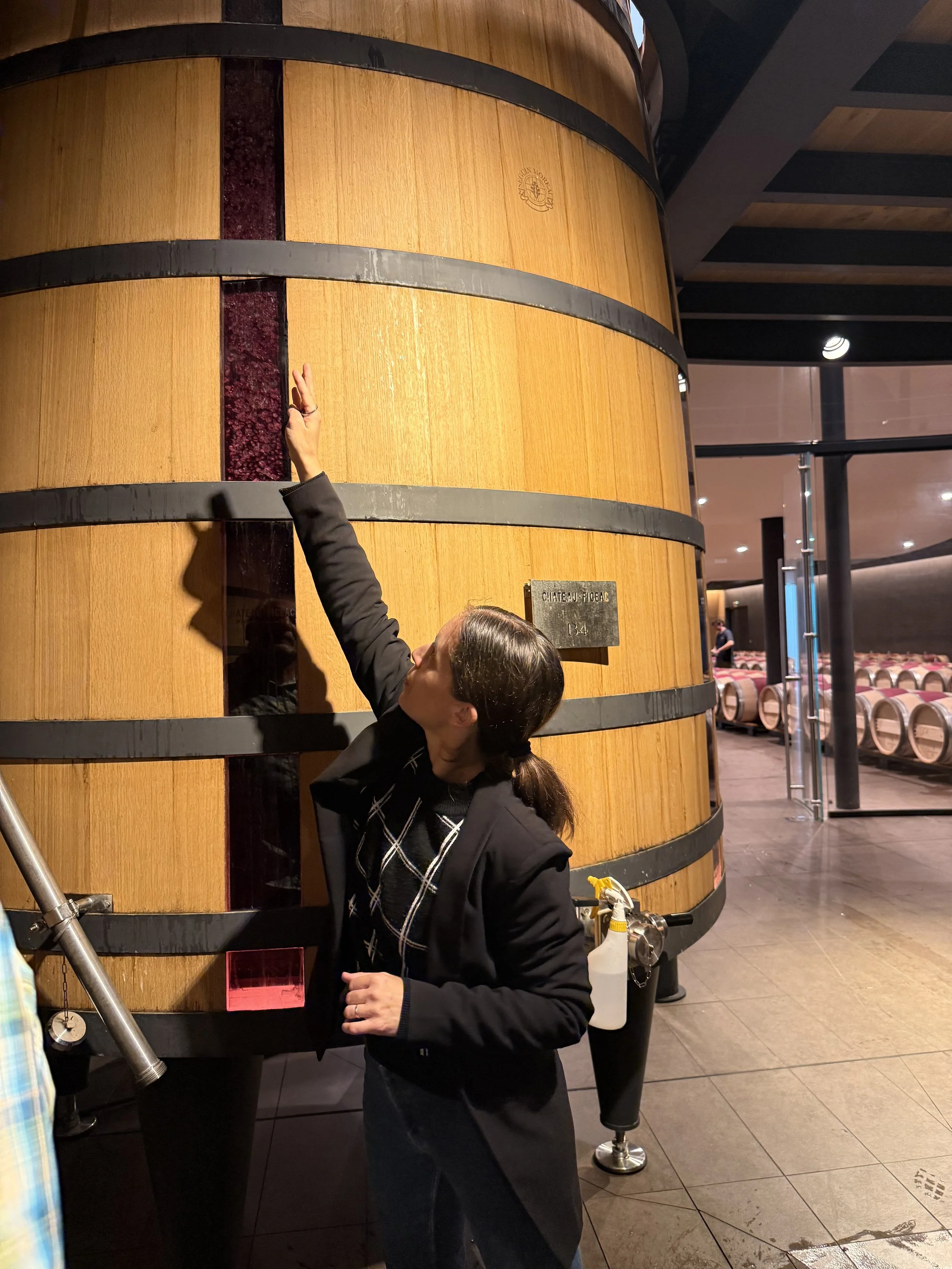
Lucile Dupuy at one of the oak vats in Figeac's new winery.
The visit. Brian and I arrived at 9:30 on 14 October. Lucile Dupuy, the estate's wine tourism guide, knew the operation thoroughly. Asked about climate change, she said the vines and soils had so far come through without problems, which is no surprise given how well that deep gravel drains. Figeac does not farm organically or biodynamically. The new production area and cellars are impressive.
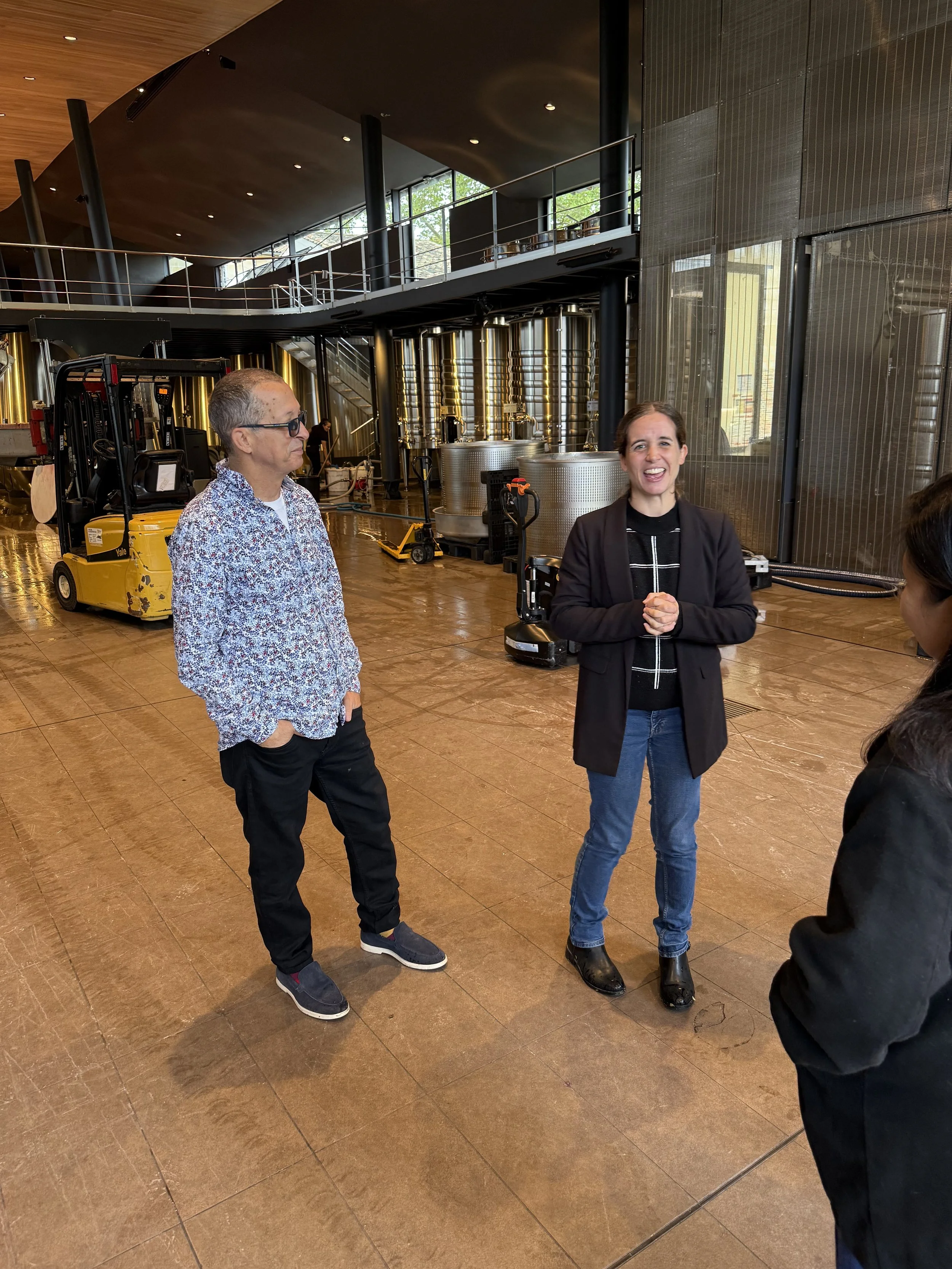
Talking production with Lucile in the vat room.
The tasting. In the tasting room we tried:
Petit-Figeac 2021 — the second wine, and my personal favourite
Château Figeac 2018 — the grand vin
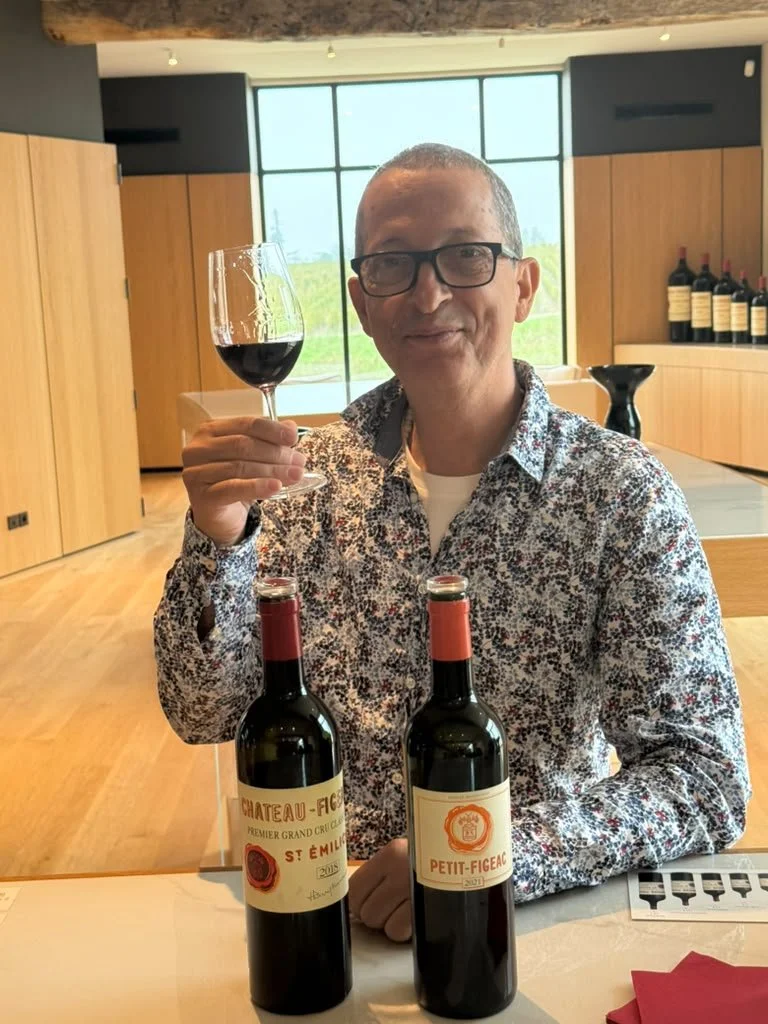
Château Figeac 2018 and Petit-Figeac 2021.
Both were exceptional. A fabulous visit, and we are grateful to Lucile for her knowledge and hospitality.
Château Tertre Rôtebœuf: one hillside, one wine, no compromises
Tertre Rôtebœuf is Bordeaux's great individualist, and a visit there is a lesson in how much a single, uncompromising vision can achieve on six hectares.
The estate. The vineyard sits in Saint-Laurent-des-Combes, on south-facing clay-limestone slopes shaped like an amphitheatre, next to Pavie and below Troplong Mondot (Grand Cru Wijnen; Decanter). François Mitjavile took it over in the late 1970s, and the next generation of the family now carries the philosophy forward. The estate makes just one wine a year from the whole vineyard: no second wine, no parcel selection. Roughly 80% Merlot and 20% Cabernet Franc yields about 2,000 cases (Wine Review Online). The family famously picks late, chasing what they call a breakdown of ripeness, and the estate stays outside the Saint-Émilion classification by choice.
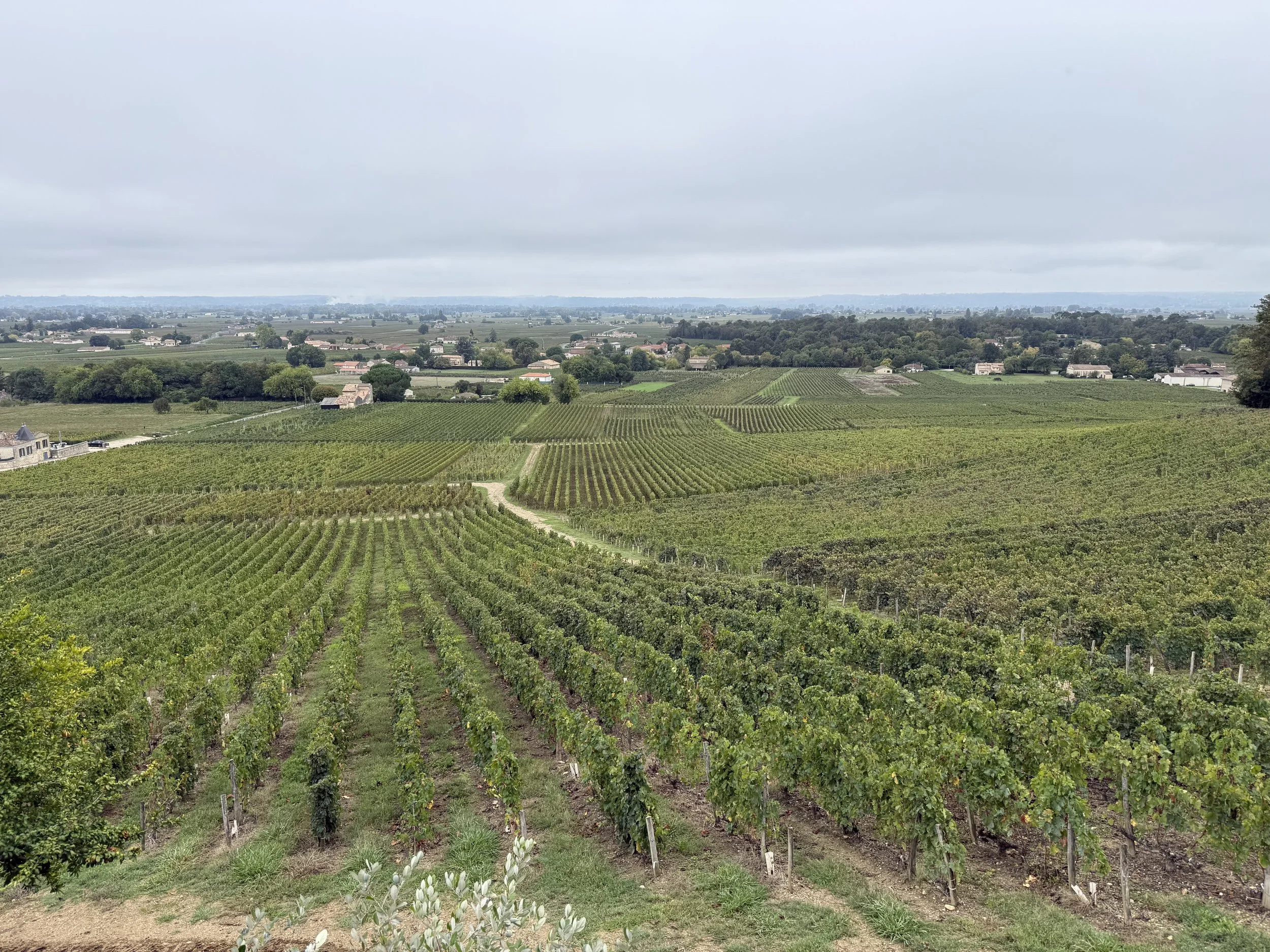
The south-facing amphitheatre of Tertre Rôtebœuf.
The visit. We came at 11:30 at the family's invitation. Rachelle greeted us and took us to her husband, Henri Mitjavile, François's son. Henri was speaking French with two other visitors in the garden and switched to English to welcome us. When I asked about organic or biodynamic farming, his answer was a firm "No" — the subject was closed. We talked instead about the property's different soils and about rabbits and wild boar eating fruit and young buds; local restaurants come to collect the boar.
The cellar. Beside the house, a small cellar held about 50 new oak barrels of the 2025 vintage, which Henri spoke of with real pride. Each vintage goes into new oak, and every barrel is used for two vintages only before it is retired. Sulphur is used sparingly, after malolactic fermentation and before bottling. We passed large concrete fermentation tanks being cleaned, then the press room, where the 2026 Cabernet Franc had just been pressed. The equipment is old but works perfectly, a reminder that great wine is made in the vineyard, not by the machinery.
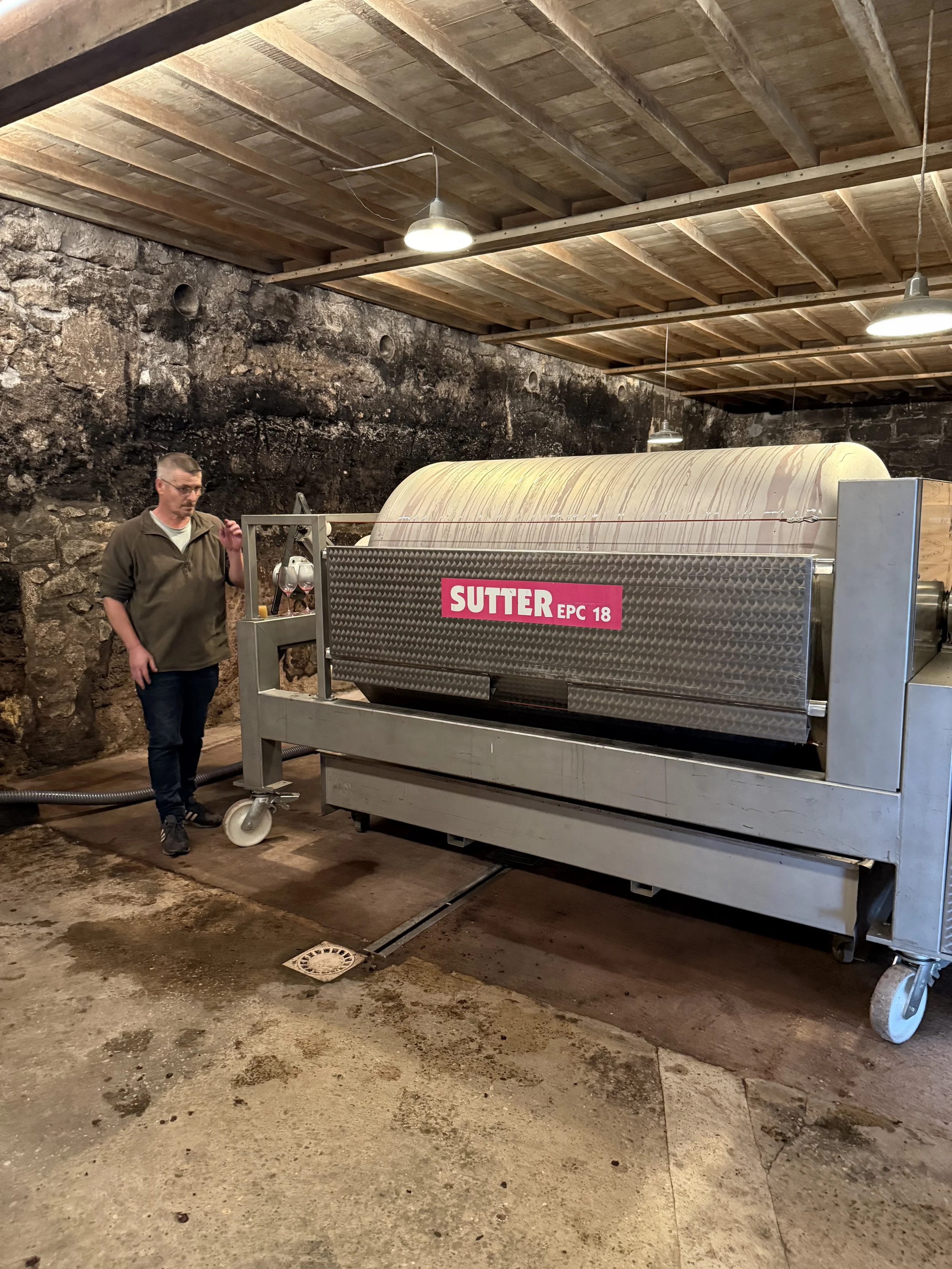
The press room, where the 2026 Cabernet Franc had just been pressed.
The tasting. We finished with two vintages:
Tertre Rôtebœuf 2003 — from Bordeaux's famous heatwave year
Tertre Rôtebœuf 2021 — from a cool, difficult vintage
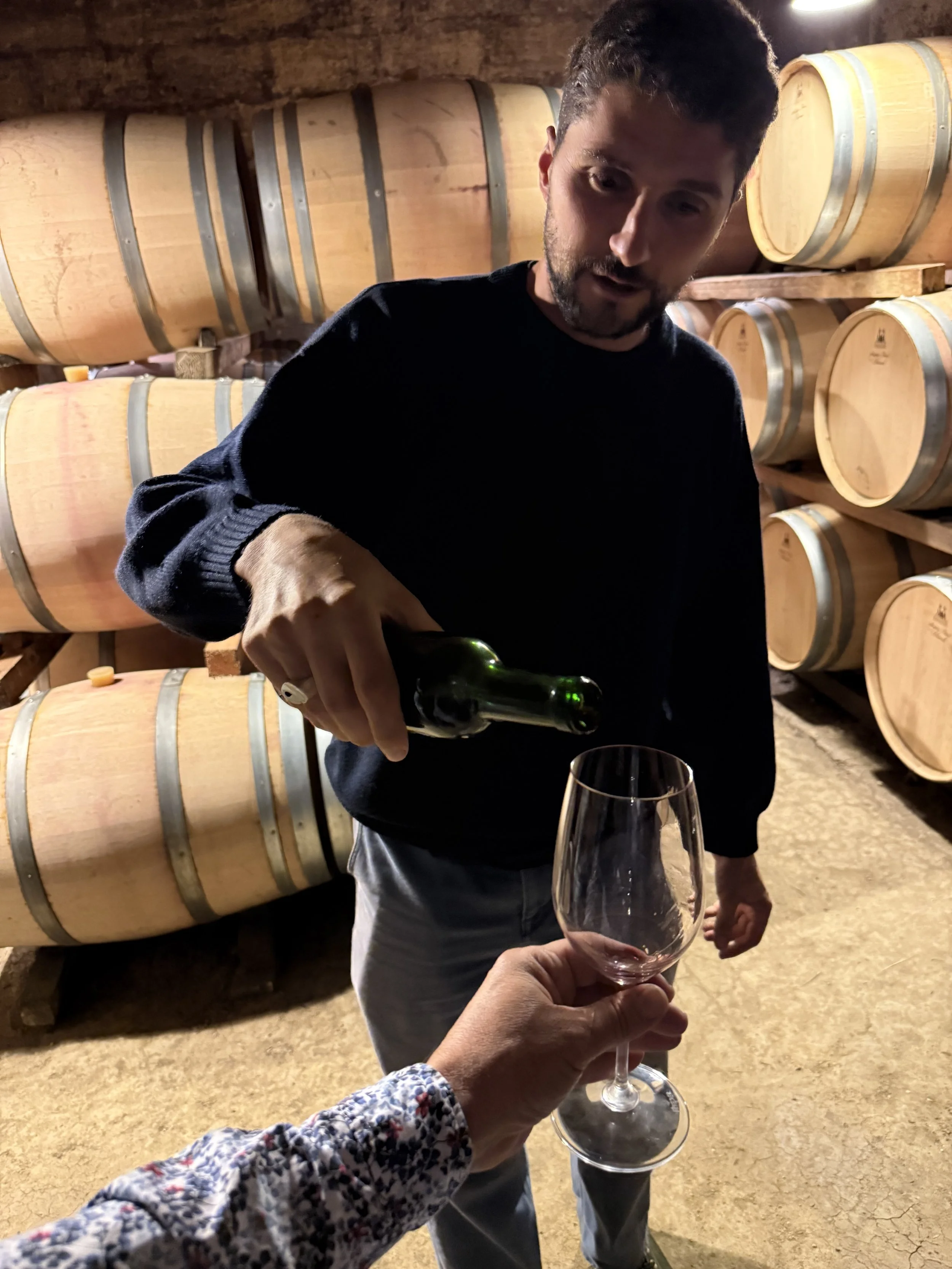
Tasting from the bottle in the barrel cellar.
Both were delicious and of excellent quality. Tasting a scorching year beside a cool one, from an estate that picks late by conviction, was the perfect end to two days spent asking about climate.
What I took away as a consultant
All four estates make superb wine today, and each is preparing for the vintages to come in its own way.
Adaptation starts with rootstock and soil. Palmer's rootstock trials, young-vine irrigation and rolled cover crops are practical steps any estate can begin, at any price point.
Climate risk is more than heat. Hail, pre-harvest rain, mildew and wildlife pressure came up at three of the four estates. A resilience plan has to cover all of them.
Terroir is a buffer. Figeac's deep gravel and Tertre Rôtebœuf's cooling clay-limestone give natural protection. Knowing your own soils plot by plot is where any plan begins.
Tell your story from the vineyard out. Visitors increasingly want to hear about the work in the vines. Estates doing serious adaptation research have a strong story to tell, and the more of it reaches the tasting room, the better.
Selection is quality. Multiple picking passes and strict fruit selection showed in every glass we tasted.
This is the work I do with estates in transition: assessing vineyards and cellars, and building practical plans for quality and climate resilience. If your estate is asking these questions, I would be glad to talk.